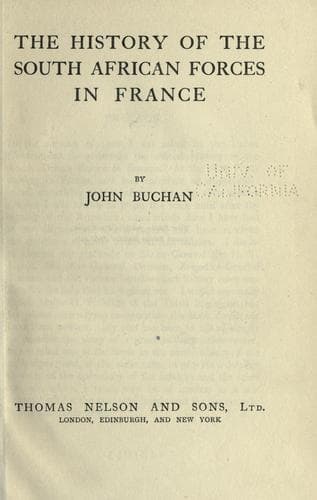
The history of the South African forces in FranceBuchan, John
History
The history of the South African forces in France
Buchan, John
South Africa. Army; World War, 1914-1918 -- Campaigns -- France; World War, 1914-1918 -- Regimental histories -- South Africa
By the next morning supports had arrived, and Plumer made a great effort
to recapture the lost ground. The 25th Division, along with French troops
and elements of the 21st and 49th Divisions, re-entered Kemmel village,
but found themselves unable to maintain it against flanking fire from the
northern slopes of the hill. After midday came the second wave of the
German assault. It failed to make ground owing to the gallant resistance
of the 49th (West Riding) Division, under Major-General Blacklock, and
of troops of the 21st, 30th, 39th, and 9th Divisions, all four of which
had been fighting for five weeks without rest. That afternoon the French
recaptured Locre, on the saddle between Kemmel Hill and the heights
to the west, so that our line in that quarter now ran just below the
eastern slopes of the Scherpenberg, east of Locre, and then south of St.
Jans-Cappel to Méteren.
[Sidenote: _April 27._]
At 2.15 that afternoon General Tanner took over command of the sector
held by the 26th Brigade. He had the 9th Scottish Rifles in line, and
the 8th Black Watch and the 5th Camerons (both of the 26th Brigade)
in support and reserve, for the South African Battalion was still in
divisional reserve at Hopoutre. Presently the Black Watch and the
Camerons were relieved by the 2nd Royal Scots Fusiliers. The South
African Brigade was for the moment under the command of the G.O.C.
49th Division. Tanner’s line ran roughly from the crossroads called
Confusion Corner, west of Vierstraat, to the southern end of Ridge Wood.
The 9th Division was now back in support, and Tanner had on his right
troops of the 49th, and on his left the 21st. The German attack came at
3 o’clock in the afternoon, and was repulsed with heavy losses; but the
9th Scottish Rifles suffered so gravely that they were relieved by the
2nd Royal Scots Fusiliers. The night passed quietly, and on the 27th the
South African Battalion, with a strength of 23 officers and 707 other
ranks, moved forward and took up position in the La Clytte-Dickebusch
support line. There it remained for two days under considerable
shell-fire, which occasioned some 60 casualties.
[Sidenote: _April 29._]
Public-domain text, read in full here on John Shaqi.
Reviews
Reviews
No reviews yet
Be the first to share your thoughts on this work.
Elsewhere in the archive
Join the Discussion
Join the discussion
Sign in to leave a comment or review.
Sign InorCreate an account