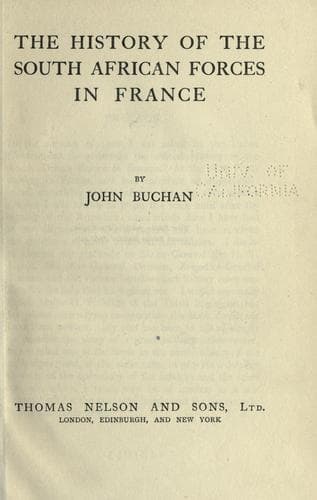
The history of the South African forces in FranceBuchan, John
History
The history of the South African forces in France
Buchan, John
South Africa. Army; World War, 1914-1918 -- Campaigns -- France; World War, 1914-1918 -- Regimental histories -- South Africa
There the South Africans remained till the last day of June, when they
came again into the front line to relieve one of the units of the
26th Brigade. At that moment the omens pointed to an elaborate German
offensive on the whole front between the Forest of Nieppe and Ypres,
with the Mont des Cats as one of the main objects of attack. But the
assault tarried, and during the first days of July the front had never
been quieter. This gave us leisure to improve our communication trenches
and link up the outposts of the front line into one continuous trench—a
most necessary work, for it had been resolved to attempt the capture of
Méteren village in the near future, and the task had been entrusted to
the 26th and South African Brigades.
[Sidenote: _July 12._]
[Sidenote: _July 18._]
The 10th of July was at first chosen as the day; but the weather grew
bad, and the operation was postponed. On the night of the 12th the South
African Brigade had been relieved by the 27th, and had returned to
Hondeghem, with orders to be in readiness to move up at short notice. The
two battalions of the Brigade selected for the assault—the South African
Composite Battalion and the 2nd Royal Scots Fusiliers—rehearsed the
business in complete detail. By the 17th the weather had improved, and on
the night of the 18th the Brigade relieved the 27th in the right sector
of the divisional front, and took up positions of assembly ready to move
on the following day.
[Sidenote: _July 19._]
Zero was fixed for five minutes to eight on the morning of the 19th. At
that hour the troops of assault left the trenches in artillery formation,
and under cover of a smoke and high-explosive barrage rapidly over-ran
the enemy front-line posts and prevented the use of his machine guns. One
or two strong-points held out till they were enveloped on the flanks.
The main attack, admirably led by the section commanders, bore down all
resistance, and both battalions reached their objectives by the appointed
time. One company of the Composite Battalion, which held the line on the
extreme right, south of the point on which the operation hinged, had been
ordered to watch for opportunities to harass the enemy while the main
attack was proceeding, and, when the barrage ceased, to push up patrols
along the front, and, if possible, capture the German trench between
Méteren Becque and the road from Brahmin Bridge to Alwyn Farm. This they
did with complete success, and took many prisoners and seven machine guns.
Public-domain text, read in full here on John Shaqi.
Reviews
Reviews
No reviews yet
Be the first to share your thoughts on this work.
Elsewhere in the archive
Join the Discussion
Join the discussion
Sign in to leave a comment or review.
Sign InorCreate an account