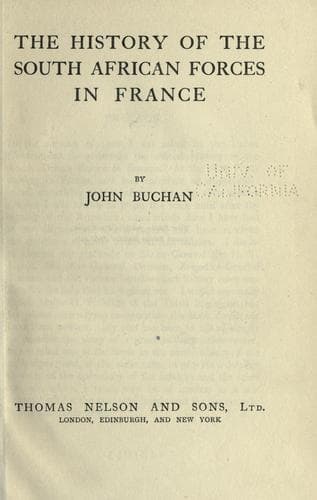
The history of the South African forces in FranceBuchan, John
History
The history of the South African forces in France
Buchan, John
South Africa. Army; World War, 1914-1918 -- Campaigns -- France; World War, 1914-1918 -- Regimental histories -- South Africa
The main attack, having reached its goal, sent out patrols, who managed
to establish themselves on a point some 200 yards north of the line
between the Gaza crossroads and the Brahmin Bridge road. There was
some stubborn fighting at Alwyn Farm and among the hedges north of it;
but in the afternoon the divisional artillery cleared the place. Under
cover of this outpost line a position in Méteren village and on the
ridge was rapidly established, and one of the most awkward corners of
the British front made secure. During the latter part of the day our
advance lines were heavily shelled, but no counter-attack developed. It
appeared that the Germans had been taken by surprise. They expected only
a gas discharge, and had in many cases put on gas masks, and were wholly
unprepared to resist the rush of our infantry.
[Sidenote: _July 20._]
[Sidenote: _July 30._]
The night passed in comparative quiet. On the morning of the 20th the
Composite Battalion was ordered to test the enemy front on the right of
the division, which seemed to have retired. Fighting patrols were pushed
out, and a line was established some 400 yards farther south. During this
action Captain Scheepers was killed; he had only rejoined the battalion
two days before. The Brigade held their sector until the 24th, when they
moved to the left of the divisional front, where for some days they were
busy in restoring and draining the dilapidated trenches. On the night of
the 30th the Composite Battalion was relieved by the 5th Camerons, and
marched back to a rest area.
The capture of Méteren was a good example of a perfectly planned and
perfectly executed minor action. The captured material consisted of 1
field gun, 13 trench mortars, and 30 machine guns, of which the Composite
Battalion’s share was 10 trench mortars and 23 machine guns. Between 200
and 300 prisoners fell to the Brigade. The casualties of the Composite
Battalion were 130, of whom 27 were killed and 2 died of wounds. Besides
Captain Scheepers, Second-Lieutenants Mackie, Anderson, Douglas, Male,
and Keeley fell, and Lieutenant Mackay was wounded.
[Sidenote: _Aug. 18._]
On 5th August the Composite Battalion was again in the line on the
right of the division, which by now extended beyond Méteren Becque, and
included Le Waton. Little happened for the better part of a fortnight
except patrol work along the Becque. On the 18th the 37th Brigade, with
the 9th Scottish Rifles, attacked and captured the mill of Hoegenacker,
taking 10 officers and 230 men prisoners. By way of retaliation the
Germans heavily shelled the South African front, in spite of which
Sergeant Thompson of the 4th Company of the Composite Battalion, with
five men, raided and captured an enemy post during the morning. That
night the battalion was relieved by the 8th Black Watch, and withdrew
from the front.
* * * * *
[Sidenote: _Aug. 28._]
Public-domain text, read in full here on John Shaqi.
Reviews
Reviews
No reviews yet
Be the first to share your thoughts on this work.
Elsewhere in the archive
Join the Discussion
Join the discussion
Sign in to leave a comment or review.
Sign InorCreate an account