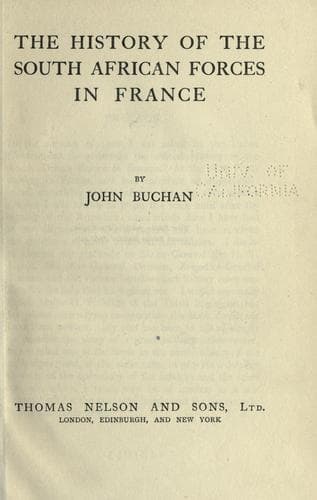
The history of the South African forces in FranceBuchan, John
History
The history of the South African forces in France
Buchan, John
South Africa. Army; World War, 1914-1918 -- Campaigns -- France; World War, 1914-1918 -- Regimental histories -- South Africa
The achievement on the 17th is worthy to rank with their advance at
Third Ypres as a brilliant feat of offensive warfare, and as such it was
praised by their comrades in arms. Brigadier-General Ian Stewart of the
XIII. Corps Headquarters Staff wrote to Tanner: “I shall always look
on the capture of the railway embankment north of Le Cateau as one of
the most astounding feats of the War. It will be good for South Africa
to know what a brave part her contingent played in the closing chapter
of the Great War, and it is no little honour to have been the foremost
troops of the British Armies in France when the curtain fell on the
greatest tragedy the world has seen.” And when the war was over and the
Brigade about to leave the 66th Division, Major-General Bethell wrote
in his special order of the day: “In after life if any of you are up
against what you imagine to be an impossible task of any description,
call to mind the Boche position on the east bank of the Selle river north
of Le Cateau, or ask some one who was there to depict it to you. Then
remember that the South African Brigade crossed that stream and took
that position, which the enemy thought impregnable to attack from that
direction, and that, on looking back at it from the enemy’s side, it was
hard to understand how the apparently impossible had been done by you.”
* * * * *
The fighting front of the XIII. Corps was now occupied by the 25th and
18th Divisions, and the 50th and 66th Divisions fell back into reserve.
The South African Brigade was in rest billets at Serain till the 2nd
November. Haig was now fairly embarked in open warfare, operating in a
difficult country of large woods, many small villages, and an infinity
of hedged enclosures. His first object was the line from Valenciennes to
the Oise-Sambre Canal along the western edge of the Mormal Forest. The
enemy had a strong water line in the canal and the Scheldt, and a good
defensive position in the forest, but between the northern end of Mormal
and the Scheldt was a gap of ten miles, and if Haig broke through the
gap the position must crumble. On Wednesday, 23rd October, he struck on
a front of fifteen miles, the Fourth Army using two corps, and the Third
Army four. This was the beginning of the last great fight of the British
Army, the Battle of the Rivers, fought in thick mists and drizzling
rain. In two days Rawlinson, Byng, and Horne advanced six miles, and
by the last day of October Haig was through the gap. Elsewhere, on the
long front of the Allies, Débeney, Mangin, and Guillaumat were each some
twenty-three miles from Hirson with an open country before them, and
Gouraud and Pershing had broken the resistance in the tangled area west
of the Meuse, and were ready for the final push on Mézières and Sedan.
Meantime strange things were happening in Berlin. The new ministry which
had come into power in Germany in the early days of October had opened
Public-domain text, read in full here on John Shaqi.
Reviews
Reviews
No reviews yet
Be the first to share your thoughts on this work.
Elsewhere in the archive
Join the Discussion
Join the discussion
Sign in to leave a comment or review.
Sign InorCreate an account