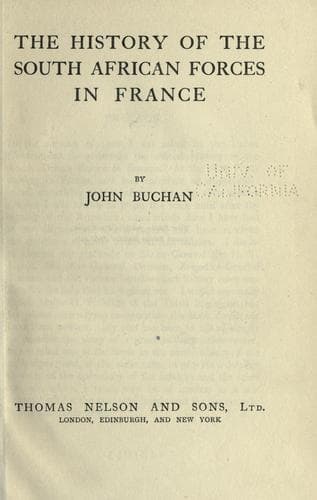
The history of the South African forces in FranceBuchan, John
History
The history of the South African forces in France
Buchan, John
South Africa. Army; World War, 1914-1918 -- Campaigns -- France; World War, 1914-1918 -- Regimental histories -- South Africa
feverish negotiations, and had made haste to recast the creed which had
hitherto been Germany’s faith. On 27th October Berlin accepted President
Wilson’s terms, which were that the only armistice to be considered must
be one that made impossible the renewal of hostilities on the part of
Germany, and was negotiated by a people’s Government and not by the
Great General Staff. The acceptance of such conditions was tantamount
to an admission of defeat in the field. On Saturday the 26th Ludendorff
resigned his command. The twilight of the gods had fallen upon his old
proud world, and the direction of affairs had gone for good from the
hands of him and his kind.
By now the condition of the German armies was in the last degree
desperate. On 21st March they had had a reserve of eighty fresh
divisions, and during the summer no division was returned to the line
without at least a month of rest and training. By 30th October they had
but one fresh division, and the intervals of rest had shrunk to nine
days. There were divisions on their front which mustered less than 1,000
rifles, and the total shortage of rifles to establishment was not less
than 500,000. Their casualties since March had been some 2,500,000, of
which at least 1,000,000 represented permanent losses. Of the 18,000
pieces of artillery on their front on 15th July, a third had since
been captured or destroyed. Worse still, they had been manœuvred into
a position from which retreat was in the long run impossible. Pershing
and Gouraud were about to cut their main trunk line in the south, and
Haig’s deadly pressure was shepherding them northward into the gap of
Liége, where, unless an armistice intervened, on the scene of their worst
infamies they would suffer a more terrible Sedan.
But it must not be thought that in those days the Allies, and especially
the British, won easy victories. The enemy resisted with a gallantry and
devotion worthy of a more honourable cause. Between the 27th September
and the 11th November our First, Third, and Fourth Armies faced and
defeated sixty-one divisions, of which twenty-one had been twice in
the battle, eight thrice, and two four times. The rearguard actions by
machine-gun posts were often brilliant and almost always resolute, and
the defence of the Selle line, notably at Le Cateau, would have done
credit to any troops. If we had broken through all the great prepared
positions, we were none the less fighting in a country which allowed
strong defences to be improvised, and the enemy did not fail to take
advantage of it.
Public-domain text, read in full here on John Shaqi.
Reviews
Reviews
No reviews yet
Be the first to share your thoughts on this work.
Elsewhere in the archive
Join the Discussion
Join the discussion
Sign in to leave a comment or review.
Sign InorCreate an account