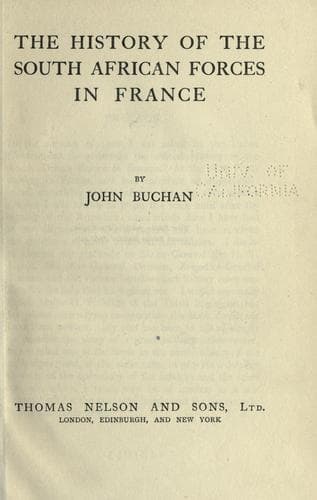
The history of the South African forces in FranceBuchan, John
History
The history of the South African forces in France
Buchan, John
South Africa. Army; World War, 1914-1918 -- Campaigns -- France; World War, 1914-1918 -- Regimental histories -- South Africa
It should be remembered, too, that he massed his main strength against
the British, for there, if anywhere, he must stand, since Haig was
marching straight for Namur and the one narrow door still open to his
frontiers. In especial he dared not weaken his artillery on that section,
and Haig had to face the bulk of the dwindling complement of German
guns. The shelling in those days seemed to many who had fought through
the War to be the heaviest they had encountered. The South African
Field Ambulance, which, under Lieutenant-Colonel Pringle and Major M.
B. Power,[27] did magnificent work at that stage (it equalled its old
record, for it was not in human power to surpass it), had a difficult
task because of the steady German shell fire, which searched out all
the back areas. As the advance grew faster, it became hard to keep up
with the infantry, and to bring back the wounded expeditiously by ruined
roads and broken bridges over distances unknown in the previous history
of the campaign.
[Sidenote: _Nov. 2-4._]
[Sidenote: _Nov. 7-9._]
On 2nd November the South African Brigade moved forward from Serain.
That day Valenciennes fell to the Canadians under Horne, and next day
the German retreat increased its pace. By Monday the 4th, Pershing, who
in three days had advanced twelve miles, had the southern railway at
Montmédy and Longuyon under his fire. That bolt-hole had been closed.
The time had come for Foch, as it came to Wellington on the evening of
Waterloo, to give the signal for “everything to go in.” On the 4th Haig
attacked on the thirty-mile front between Valenciennes and the Sambre,
and by the next day the Forest of Mormal was behind him. The enemy’s
resistance was finally broken, and his armies were not in retreat but in
flight, with their two wings for ever separated. Through the fifty-mile
pocket between Avesnes and Mézières the whole German forces in the south
must squeeze if they would make good their escape, and the gap was
hourly narrowing. Mangin and Guillaumat were close on Hirson, Gouraud
and Pershing were approaching Mézières, and Haig had the Sambre valley
as an avenue to Namur. Moreover, Foch had still his trump card to play,
the encircling swing of a new American army north of Metz to cut off
the enemy from his home bases. If a negotiated armistice did not come
within the week, there would be a _de facto_ armistice of collapse and
surrender. On the 7th Byng was in Bavai, and on the 8th in front of
Maubeuge. That day Rawlinson took Avesnes, and on the 9th the Guards
entered Maubeuge, while farther north Condé and Tournai were in our
hands. On the 6th Gouraud was in Rethel, and on the 7th Pershing was in
the western skirts of Sedan. On the 6th the German delegates, Erzberger
and his colleagues, left Berlin on their embarrassed journey to Foch’s
headquarters. On the 9th came the revolution in Berlin, and the formation
of a Council of National Plenipotentiaries under Ebert. Next day the
Public-domain text, read in full here on John Shaqi.
Reviews
Reviews
No reviews yet
Be the first to share your thoughts on this work.
Elsewhere in the archive
Join the Discussion
Join the discussion
Sign in to leave a comment or review.
Sign InorCreate an account