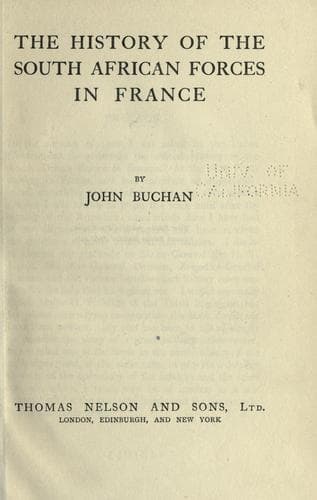
The history of the South African forces in FranceBuchan, John
History
The history of the South African forces in France
Buchan, John
South Africa. Army; World War, 1914-1918 -- Campaigns -- France; World War, 1914-1918 -- Regimental histories -- South Africa
On returning to the line on 2nd August, the Brigade took up positions
farther south in the neighbourhood of Hulluch. On the 22nd its
Headquarters were heavily shelled, and one member of the staff was
killed. During August and September the batteries supported the steady
pressure maintained along this sector in anticipation of the German
retirement, all moving to forward positions. On the 2nd October the
enemy fell back three miles to the line of the Haute-Deule Canal, and
the advance of the Fifth Army began. As soon as roads were repaired, the
guns moved up to Douvrin, Hulluch, and Wingles, and on the 12th October
assisted in the capture of Vendin by the 15th Division. Owing to the
difficulty of bridging the many canals, siege batteries could only follow
very slowly, and the Germans were on the line of the Scheldt before they
came again into action. The enemy kept up a heavy bombardment during the
first week of November, and on the night of the 6th the Brigade suffered
its last casualties in the war. The bridging of the Scheldt was in rapid
progress, and the batteries were preparing to advance across the river,
when on the 11th hostilities ceased.
THE 74TH SIEGE BATTERY, R.G.A.
The 74th Battery landed at Havre on April 30, 1916, under the command
of Major Pickburn. It proceeded to Authuille, and on 4th May took
up position at Bienvillers-au-Bois. On the first day of the First
Battle of the Somme its four guns fired 1,733 rounds, supporting the
unsuccessful attack of the infantry at Gommecourt. It then took over
the position of the 73rd Battery, and later on, 27th August, moved to
the Martinsart-Aveluy road for the operations against Thiepval. On 7th
October it was in the orchard at Colincamp, a place without cover and
a favourite target for the enemy. There it spent some desperate weeks.
On 7th November the battery-commander, Major Pickburn, was killed. On
the 20th November the enemy kept up a severe bombardment all day, and
four gunners lost their lives. It was the same on the 29th, when an
armour-piercing shell penetrated to a cellar protected by seven feet
of earth and bricks, and killed the three occupants. The position was
really untenable for a heavy battery, but it was held till early in
December, when a move was made to Auchonvillers. It presently moved to
Gouy-en-Artois, and then to Arras and the Faubourg d’Amiens. In the early
weeks of the year it was at Rivière, opposite Ficheux, and then again in
a suburb of Arras.
Public-domain text, read in full here on John Shaqi.
Reviews
Reviews
No reviews yet
Be the first to share your thoughts on this work.
Elsewhere in the archive
Join the Discussion
Join the discussion
Sign in to leave a comment or review.
Sign InorCreate an account