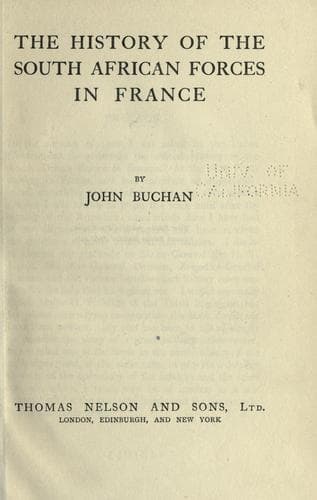
The history of the South African forces in FranceBuchan, John
History
The history of the South African forces in France
Buchan, John
South Africa. Army; World War, 1914-1918 -- Campaigns -- France; World War, 1914-1918 -- Regimental histories -- South Africa
In the battle of Arras the Battery supported the advance of the South
African Infantry Brigade, and on the 12th its right section was in the
old German line at Point de Jour, supporting the fighting in the Oppy,
Gavrelle, and Rœux area. At that time they were the farthest forward
siege guns on the British front. There the Battery continued till the
battle died away. Major Tamplin was gassed and returned to England, Major
Murray-MacGregor taking over the command. By 5th July the whole Battery
had moved to the Ypres neighbourhood, where it took up ground on the
canal bank near “Shrapnel Corner.” There, during the first stages of
Third Ypres, it suffered the usual fate of combatants in the Salient.
Major Murray-MacGregor was succeeded in the command by Major G. M.
Bennett. Presently it moved to a position on the Verbranden-Molen road,
and a little later to Hooge. This was its station during the remainder
of the battle. It had many casualties from shell, fire, and gas, and the
reliefs coming by the Menin road had to face an incessant enemy barrage.
The total men available on each shift were only seventeen for all four
guns, and had not three of the guns been knocked out the task would have
been impossible. When at last the Battery was withdrawn, it was reduced
to 1 gun and 70 men.
On 21st December the Battery, now brought up to strength, went back to
the line as part of the 50th (S.A.) Brigade, R.G.A.
THE 72ND SIEGE BATTERY, R.G.A.
The 72nd Battery landed in France on April 21, 1916, under the command
of Major C. W. Alston. Its first position was at Mailly-Maillet, where
with a very short allowance of ammunition it entered upon its field
experience. It was sent to Ypres on 3rd June along with the 71st to
assist the Canadians, where it had some hard fighting, Major Alston being
severely wounded, and Captain A. G. Mullins taking over the command.
Returning to Mailly, it took part in the opening days of the First
Somme, and then moved first to Englebelmer, and then to Authuille. This
last was an excellent position, with a steep bank in front of the guns
and the Ancre in the rear. The Battery remained there for eight months,
until the retirement of the enemy enabled it to advance to Thiepval and
Grandcourt.
On March 22, 1917, it moved to the Arras neighbourhood, taking up ground
near Berthonval Wood, a few miles east of Mont St. Eloi. From this
position the Battery shared in the battle for Vimy, after the fall of
which it moved forward to Souchez, under the northern end of the ridge.
On 30th April it retired to Houdain for its first spell of rest since
it arrived in France. On 12th May it was at Thélus, and four days later
it was transferred to the 1st Canadian Heavy Artillery Group, and took
up position at Zouave valley, near Givenchy, in the Vimy area. There it
remained for three months, supporting the Canadian attack at Lens.
Public-domain text, read in full here on John Shaqi.
Reviews
Reviews
No reviews yet
Be the first to share your thoughts on this work.
Elsewhere in the archive
Join the Discussion
Join the discussion
Sign in to leave a comment or review.
Sign InorCreate an account