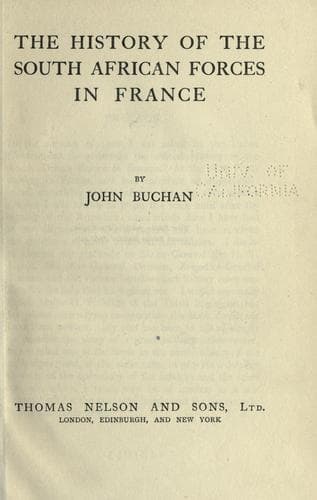
The history of the South African forces in FranceBuchan, John
History
The history of the South African forces in France
Buchan, John
South Africa. Army; World War, 1914-1918 -- Campaigns -- France; World War, 1914-1918 -- Regimental histories -- South Africa
When these difficulties had been more or less successfully disposed of
and laying commenced, a minor but vital detail in the material threatened
disaster. The cable coming forward proved to be mainly single D 5—_i.e._
the standard army cable as supplied for overground use in mobile
warfare, when few lines are laid and there is no objection to the earth
constituting the return circuit. The results already known to have been
obtained by the enemy in picking up our messages through earth by means
of sensitive listening telephone apparatus, had already caused the issue
of stringent orders that all lines within 1,600 yards—later increased to
3,000 yards—of the front line must be metallic circuits—_i.e._ each line
had to consist of a pair of insulated wires. Also, owing to inductive
effects when a number of pairs of wires are laid closely parallel to each
other, as in a trench, a conversation over one pair will be heard in the
other circuits unless each pair is twisted. The use of the single cable,
therefore, not only doubled the work of laying (as each line necessitated
two separate wires), but the untwisted pairs so formed would render the
lines noisy and possibly entirely unworkable. Utilizing the frame of a
cable wagon trail, and one of its wheels as a foundation, a machine was
rapidly improvised by the section on which the drums of single cable were
mounted as received, spun into twisted cable, and simultaneously reeled
off on other drums for the laying parties. This apparatus was kept going
and running at high pressure by the section wheeler, Sapper Page, with
a few Artillery Headquarters’ grooms and batmen as his only available
assistants.
By such strenuous efforts the programme was completed, and when the
preparatory bombardment opened, 500 miles of cable had been laid and
joined up in over twenty miles of cable trench, and every battery had
excellent and reliable communication forward to its observation posts
and back to its group commander. Two dug-outs had been constructed on
each flank, into which all O.P. lines were led and terminated on special
switchboards, designed and made up at the Company Headquarters.
Through these O.P. exchanges any battery could be connected to any
O.P. for control of fire, which proved most valuable in the changing
circumstances of the fighting. At that date the establishment of neither
groups nor batteries included switchboards for metallic circuit lines.
The necessary number—over thirty—were improvised in a few days at the
Company workshops out of electric light fittings purchased in Amiens.
Public-domain text, read in full here on John Shaqi.
Reviews
Reviews
No reviews yet
Be the first to share your thoughts on this work.
Elsewhere in the archive
Join the Discussion
Join the discussion
Sign in to leave a comment or review.
Sign InorCreate an account