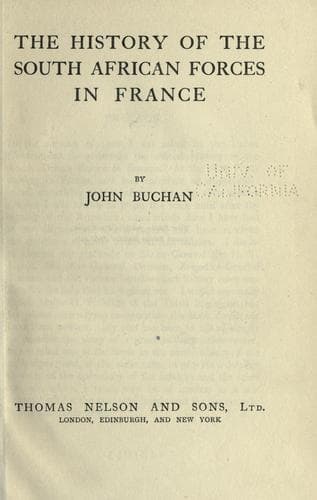
The history of the South African forces in FranceBuchan, John
History
The history of the South African forces in France
Buchan, John
South Africa. Army; World War, 1914-1918 -- Campaigns -- France; World War, 1914-1918 -- Regimental histories -- South Africa
Such transport conditions bore more hardly on signals than any other
service. With activities spread over the whole area, a very limited
_personnel_ and transport, and ever-changing conditions, which
often stultified by nightfall all the laborious effort of the day,
the difficulty of getting parties to a given spot at a given time,
co-ordinating the supply of materials and labour, controlling the working
parties and switching them to meet emergencies as they arose, was a
splendid schooling in patience, temper, and too often in resignation to
fate. This remained the paramount factor in the Company’s experience
throughout the Somme. As an example, a cable wagon of B.E. section took
its place in a melancholy queue at 7 a.m., and arrived at its working
point near Montauban at 2 p.m., to lay a short line required urgently at
noon, and involving about half an hour’s work. The party returned via
Carnoy in accordance with the traffic circuit, and encountering similar
conditions, reached headquarters near Méaulte at 10 p.m., with horses
and men exhausted. Under the same difficulties, 51 Air Line Section was
engaged in following up the advance with a light open wire route up to
Fricourt, and B.G. and B.F. Sections were worked with the 21st Division
Signals and the Corps Observers respectively.
The commencement of active operations brought the work of the operators
and the despatch riders at headquarters and with the heavy artillery to
a point of extreme pressure, which was maintained with little variation
throughout the following months. Up to two thousand telegrams, and a
larger number still of D.R.L.S. packets, were received or despatched
daily. The telephone exchanges at Corps and Heavy Artillery Headquarters,
with over sixty and thirty connections respectively, worked hard day and
night, handling urgent priority calls; but so keen and expert were the
operators that a service was maintained equal, if not superior, to the
highest civilian standard. The destruction of lines by hostile shelling
and traffic was met by the skilful use of alternative routes and by the
quickness and energy of the maintenance linemen. However, the incessant
strain to which the operators were subjected soon began to affect their
nerves, and before the Company was withdrawn men resting off duty could
be heard answering imaginary calls in their sleep.
Public-domain text, read in full here on John Shaqi.
Reviews
Reviews
No reviews yet
Be the first to share your thoughts on this work.
Elsewhere in the archive
Join the Discussion
Join the discussion
Sign in to leave a comment or review.
Sign InorCreate an account