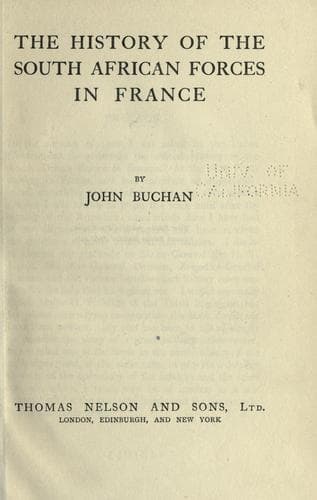
The history of the South African forces in FranceBuchan, John
History
The history of the South African forces in France
Buchan, John
South Africa. Army; World War, 1914-1918 -- Campaigns -- France; World War, 1914-1918 -- Regimental histories -- South Africa
The attack began at 4.30 a.m. with an intense bombardment extending back
to and beyond the river, followed by an infantry assault about 7 a.m.,
which immediately broke through the Portuguese on the Corps right. There
were no reserves available to man effectively the new line dug on the
northern bank, and during the afternoon the enemy crossed at Bac St.
Maur, and by 7 p.m. had forced our firing line back behind the signal
test point at Croix de Bac. Communications had held well so far; the 34th
Division was still maintaining its ground on the left round Armentières,
and there was hope of an immediate restoration of the situation by
counter-attack. The lineman at this point—Corporal Shepherd of the H.A.
section—was, therefore, instructed not to destroy the lines, but to
leave them all through, and fall back on the next test point. He did so,
but omitted to put through one of the lines. On ascertaining this when
he reached H.A. headquarters, he voluntarily returned and managed to
re-enter the dug-out, which was now in No Man’s Land, and put the line
through. Though this dug-out passed into the enemy’s hands during the
night, and after a temporary reversal of fortune again next morning,
direct communication from Corps headquarters to troops in Armentières
was maintained over the cables passing through it till afternoon on the
following day, when the evacuation of the town began.
By next morning the Germans had forced the river to Estaires. This town
had been intensely shelled all day, and B.E. Section billet was blown up
early in the morning. Nevertheless, the Corps Exchange was kept going
till a late hour that night by Lieutenant Hill with 51 Air Line and a
party of operators from the Headquarters section.
During the following days, the 10th, 11th, and 12th, the Corps was
steadily driven back by the heavy thrust made by the enemy for
Hazebrouck. The 29th and 31st Divisions and the 4th Guards Brigade were
successively thrown in, but their desperate fighting only succeeded
in slowing the German advance, until the entry into line of the 1st
Australian Division on the night of the 12th, when the enemy was finally
brought to a stop on the edge of the Nieppe Forest. Thereafter the storm
centre shifted gradually to the northward round Kemmel and Messines,
while on the Corps front the battle died down to local combats.
Public-domain text, read in full here on John Shaqi.
Reviews
Reviews
No reviews yet
Be the first to share your thoughts on this work.
Elsewhere in the archive
Join the Discussion
Join the discussion
Sign in to leave a comment or review.
Sign InorCreate an account