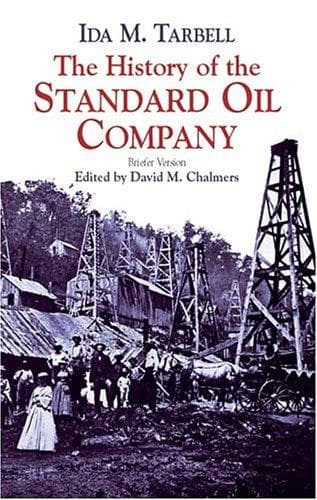
The History of the Standard Oil CompanyTarbell, Ida M. (Ida Minerva)
History
The History of the Standard Oil Company
Tarbell, Ida M. (Ida Minerva)
Petroleum industry and trade -- United States -- History; Standard Oil Company -- History
There were few tears shed in the Oil Regions over the rupture of the
contract. The greater part of the oil men had called it from the
beginning an “unholy alliance,” and rejoiced that it was a fiasco. If
the alliance had been all that came to an end, the case would not have
been so serious, but it was not. The breaking of the alliance proved the
death of the agency and the association. The leaders who had disapproved
of the treaty withdrew from active work; the supporters of the alliance,
demoralised by its failure, were glad to keep quiet. A few spasmodic
efforts to stop the drill, to inaugurate another shut-down, were made,
but failed. Most of the producers felt that, as oil was so low, their
only safety was in getting as large a production as they could, and a
perfect fever of development followed. The Producers’ Association, after
ten months of as exciting and strenuous effort as an organisation has
ever put in, was snuffed out almost in a day. It was to be five years
before the oil men recovered sufficiently from the shock of this
collapse to make another united effort. If Mr. Rockefeller felt in the
fall of 1872 that the “good of the oil business” required the
dissolution of the Producers’ Agency, he could not have acted with more
acumen than he did in leading them into an alliance, and at the
psychological moment throwing up his contract.
Humiliated as the producers were by their failure, they soon found
consolation in the knowledge that the Refiners’ Association was in
trouble. A serious thing, in fact, had happened. When the official
report of the year’s exports and imports came out, it was shown that the
exports of refined oil had fallen off for the first time in the history
of the business. In 1871, 132,178,843 gallons had been exported. In
1872, only 118,259,832 were exported. Just as alarming was the proof
that the shale and coal-oil refineries of Europe had taken a fresh
start—that they were selling their products more cheaply than kerosene
could be imported and sold. There was a general outcry from all over the
country that Mr. Rockefeller and his associates were running the oil
business by keeping up the price of refined oil beyond what the price of
crude justified. The producers, eager for a scapegoat, argued that the
low price of crude was due to decreased consumption as well as
over-production, and their ill-will against Mr. Rockefeller flared up
anew. In the meantime the Refiners’ Association was having troubles of
its own. The members were not limiting their output as they had
agreed—that is, it was discovered every now and then that a refinery was
making more oil than Mr. Rockefeller had directed. Again, what was more
fatal to the success of the association, members sometimes sold at a
lower price than that set by Mr. Rockefeller. These restrictions were
fundamental to the success of the combination, and the members were
called together at Saratoga in June, 1873, and after a long session the
association was dissolved.
Public-domain text, read in full here on John Shaqi.
Reviews
Reviews
No reviews yet
Be the first to share your thoughts on this work.
Elsewhere in the archive
Join the Discussion
Join the discussion
Sign in to leave a comment or review.
Sign InorCreate an account