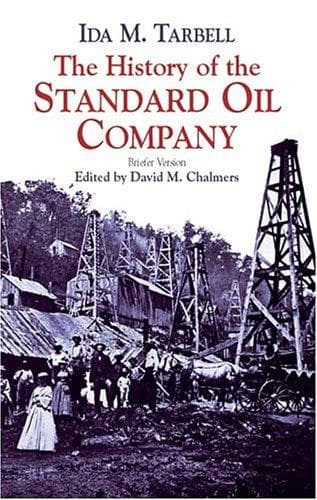
The History of the Standard Oil CompanyTarbell, Ida M. (Ida Minerva)
History
The History of the Standard Oil Company
Tarbell, Ida M. (Ida Minerva)
Petroleum industry and trade -- United States -- History; Standard Oil Company -- History
There was loud exultation in the unthinking part of the Oil Regions over
the dissolution of the refiners. The “Junior Anaconda” was dead. The
wiser part of the region did not exult. They knew that though the
combination might dissolve, the Standard Oil Company of Cleveland still
controlled its one-fifth of the capacity of the country; that not only
had Mr. Rockefeller been able to hold the twenty refineries he had
bolted so summarily at the opening of 1872, but he had assimilated them
so thoroughly that he was making enormous profits. Mr. Rockefeller’s
contracts with the Central Railroad alone in 1873 and 1874 obliged him
for seven months of the year to ship at least 100,000 barrels of refined
oil a month to the seaboard. As a matter of fact he never shipped less
than 108,000 barrels, and in one month of the period it rose to
180,000.[33] Now in 1873 he made, at the very lowest figure, three cents
a gallon on his oil. Estimating his shipments simply at 700,000 barrels
a year—and they were much more—his profits for that year were
$1,050,000, and this accounts for no profits on about thirty-five per
cent. of the Standard output, which was sold locally or shipped
Westward. Little wonder that the Cleveland refiners who had been snuffed
out the year before, and who saw their plants run at such advantage,
grew bitter, or that gossip said the daily mail of the president of the
Standard Oil Company was enlivened by so many threats of revenge that he
took extraordinary precautions about appearing unguarded in public.
It is worth noticing that these great profits were not being used for
private purposes. In 1872 the Standard Oil Company paid a dividend of
thirty-seven per cent., but in 1873 they cut it to fifteen per cent. The
profits were going almost solidly into the extension and solidification
of the business. Mr. Rockefeller was building great barrel factories,
thus cutting down to the minimum one of a refiner’s heaviest expenses.
He was buying tank cars that he might be independent of the vagaries of
the railroads in allotting cars. He was gaining control of terminal
facilities in New York. He was putting his plants into the most perfect
condition, introducing every improved process which would cheapen his
manufacturing by the smallest fraction of a cent. He was diligently
hunting methods to get a larger percentage of profit from crude oil.
There was, perhaps, ten per cent. of waste at that period in crude oil.
It hurt him to see it unused, and no man had a heartier welcome from the
president of the Standard Oil Company than he who would show him how to
utilise any proportion of his residuum. In short, Mr. Rockefeller was
strengthening his line at every point, and to no part of it was he
giving closer attention than to transportation.
CHAPTER FIVE
LAYING THE FOUNDATIONS OF A TRUST
Public-domain text, read in full here on John Shaqi.
Reviews
Reviews
No reviews yet
Be the first to share your thoughts on this work.
Elsewhere in the archive
Join the Discussion
Join the discussion
Sign in to leave a comment or review.
Sign InorCreate an account