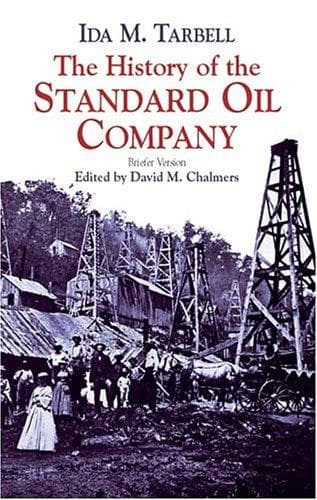
The History of the Standard Oil CompanyTarbell, Ida M. (Ida Minerva)
History
The History of the Standard Oil Company
Tarbell, Ida M. (Ida Minerva)
Petroleum industry and trade -- United States -- History; Standard Oil Company -- History
EVIDENCE OF REAPPEARANCE OF REBATES SOON AFTER AGREEMENT OF MARCH 25
IS SIGNED—PRINCIPLE THOROUGHLY ESTABLISHED THAT LARGE SHIPPERS SHALL
HAVE ADVANTAGES OVER SMALL SHIPPERS IN SPITE OF RAILROADS’ DUTY AS
COMMON CARRIERS—AGREEMENT WORKED OUT BY WHICH THREE ROADS ARE TO
HAVE FIXED PERCENTAGE OF EASTERN SHIPMENTS—OIL REGIONS ROBBED OF
THEIR GEOGRAPHICAL ADVANTAGE—THE RUTTER CIRCULAR—ROCKEFELLER NOW
SECRETLY PLANS REALISATION OF HIS DREAM OF PERSONAL CONTROL OF THE
REFINING OF OIL—ORGANISATION OF THE CENTRAL ASSOCIATION—H. H.
ROGERS’ DEFENCE OF THE PLAN—ROCKEFELLER’S QUIET AND
SUCCESSFUL CANVASS FOR ALLIANCES WITH REFINERS—THE REBATE HIS
WEAPON—CONSOLIDATION BY PERSUASION OR FORCE—MORE TALK OF A UNITED
EFFORT TO COUNTERACT THE MOVEMENT.
Throughout 1872, while the producers and refiners were working out
associations and alliances to regulate the output of crude and refined
oil, the freight rates over the three great oil-carrying roads were
publicly supposed to be those settled by the agreement of March 25.
Except by the sophisticated it was believed that the railroads were
keeping their contracts. The Lake Shore and Michigan Southern and the
New York Central had never kept them, as we have seen. Mr. Flagler’s
statement that the Standard received a rebate of twenty-five cents a
barrel from April 1 to November 15, 1872, would seem to show that while
with one hand Mr. Clark and Mr. Vanderbilt signed the agreement with the
oil men that henceforth freights should be “on a basis of perfect
equality to all shippers, producers and refiners, and that no rebates,
drawbacks, or other arrangements of any character should be made or
allowed that would give any party the slightest difference in rates or
discriminations of any character whatever,” with the other they had
signed an arrangement to give a twenty-five-cent rebate to Mr.
Rockefeller! They certainly had a strong incentive for ignoring their
pledge. Consider what Mr. Rockefeller could offer the road—sixty
car-loads of oil a day, over 4,000 barrels. General Devereux points out
in the affidavit already mentioned[34] what this meant. It permitted
them to make up a solid oil train and run it out every day. By running
nothing else they reduced the average time of a freight car from
Cleveland to New York and return from thirty days to ten days. The
investment for cars to handle their freight was reduced by this
arrangement to about one-third what it would have been if several
different persons were shipping the same amount every day. Promptness
was insured in forwarding and returning (a drawback of from fifty
dollars to $150 a day accrued if it was late, so that the Standard was
bound to ship promptly), and all the inconvenience of dealing with many
shippers each with his peculiar whim or demand was avoided. It was
certainly worth a rebate to the Central, and the Central not having any
prejudices in favour of keeping agreements because they were agreements
Public-domain text, read in full here on John Shaqi.
Reviews
Reviews
No reviews yet
Be the first to share your thoughts on this work.
Elsewhere in the archive
Join the Discussion
Join the discussion
Sign in to leave a comment or review.
Sign InorCreate an account