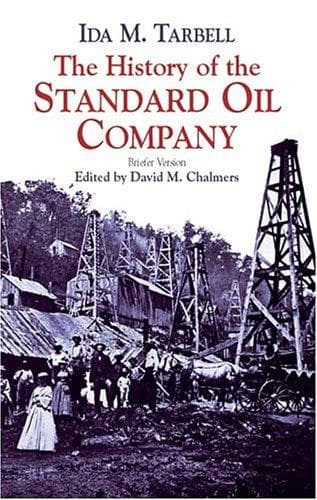
The History of the Standard Oil CompanyTarbell, Ida M. (Ida Minerva)
History
The History of the Standard Oil Company
Tarbell, Ida M. (Ida Minerva)
Petroleum industry and trade -- United States -- History; Standard Oil Company -- History
naturally conceded what Mr. Rockefeller wanted. There was another point.
If the Central did not concede to Mr. Rockefeller’s terms it undoubtedly
would lose the freight. There was the lake and the canal and there was
the Erie!
Now it is not supposable that such an arrangement would go on long
without leaking out in the upper oil circles. We have evidence that it
did not. Indeed, there was among certain intelligent oil men a
conviction when the agreement was signed that the New York roads would
not regard it—that if they did it would ruin the refining business of
Cleveland. W. T. Scheide, a member of the oil men’s committee making
this contract, the agent of one of the largest oil shippers in the
country, Adnah Neyhart, in some frank and suggestive testimony given to
the Hepburn Committee in 1879, said that at the time the arrangement was
made he did not think anybody connected with the business expected it
would last. “My reason for that was that it was an impossible
agreement,” said Mr. Scheide. “The immediate effect of it would have
been to have utterly destroyed fifty-five per cent. of the refining
interest of the country; that is to say, Cleveland and Pittsburg, which
during the previous four years had shipped fifty-five per cent. of all
the oil out of the Oil Regions—they, in addition to paying the rates of
freights which all other refiners would have had to pay, were required
to pay fifty cents a barrel on their crude oil to their works.” The
refiners in Cleveland and Pittsburg had of course always paid to get
crude oil to their works, even the South Improvement Company tariffs
provided for that, and under that arrangement Cleveland had come to be
in 1871 the chief refining centre of the country. The chairman of the
committee examining Mr. Scheide suggested it was a “temporary
impossibility which would have adjusted itself,” which Mr. Scheide
admitted. “Yes, sir, naturally, it would have adjusted itself I suppose,
but the effect was very marked at the time.”
So strong was Mr. Scheide’s conviction that the New York roads would not
stand the new rates that on the 10th of April he went to the
Pennsylvania railroad and asked for a rebate on Mr. Neyhart’s crude
shipments—and got it. What the rebate was he does not state, but Mr.
Flagler tells us in his testimony[35] that in December he discovered
that the Pennsylvania was shipping for as low as $1.05 a barrel. And for
one month he got from Mr. Vanderbilt a rate of $1.05 on his 4,000
barrels a day.
Public-domain text, read in full here on John Shaqi.
Reviews
Reviews
No reviews yet
Be the first to share your thoughts on this work.
Elsewhere in the archive
Join the Discussion
Join the discussion
Sign in to leave a comment or review.
Sign InorCreate an account