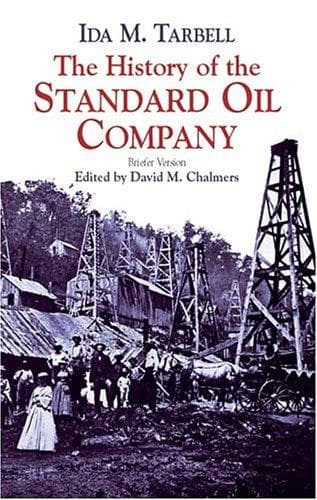
The History of the Standard Oil CompanyTarbell, Ida M. (Ida Minerva)
History
The History of the Standard Oil Company
Tarbell, Ida M. (Ida Minerva)
Petroleum industry and trade -- United States -- History; Standard Oil Company -- History
Mr. Scheide was also shipping refined oil over the Erie. George R.
Blanchard, who in October, 1872, became the general freight agent of the
Erie, told the Hepburn Committee in 1879 that he found on entering his
position that $7,000 in rebates had been paid Mr. Scheide for Mr.
Neyhart in the month of September, 1872, on this refined. He does not
say how long this had been going on. Mr. Blanchard found at the same
time the March 25 agreement. He asked why it was not observed, and the
reply convinced him that it had not been kept more than two weeks by the
Pennsylvania and Central systems. “The representations made to me,” says
Mr. Blanchard, “also convinced the Atlantic and Great Western as to what
our rivals were doing, and that railway company and our own decided to
continue to pay the twenty-four cents per barrel drawback then being
paid on the rate of $1.35, provided by their producers’ agreement of
March 25, 1872.”
But Mr. Blanchard was shipping only Mr. Neyhart’s refined, and naturally
he looked for more business and was willing to give a rebate to get it.
He soon had some from another of the oil men who had signed the
agreement of March 25. This was Mr. Bennett, of Titusville, who with J.
D. Archbold and his other partners entered into a contract with Mr.
Blanchard to ship their entire product for a year at a rate considerably
below the one agreed upon on March 25.[36] The contract was a
short-lived one, for in November Mr. Bennett and his partners turned
their shipments over to the Pennsylvania. The Erie had some
compensation, however, in the fact that in July, 1873, Mr. Neyhart’s
crude shipments had all come to them. Mr. Scheide, Mr. Neyhart’s agent,
explained to the Hepburn Commission that he left the Pennsylvania
because of what he considered “very bad treatment—a discrimination
against us in furnishing us cars.” The Pennsylvania had indeed
undertaken to carry out the clause in the agreement of March 25 which
stipulated that there should be no discrimination in furnishing cars.
Mr. Scheide, considering himself “their shipper,” that is, shipping
larger quantities more regularly than anybody else, and as a consequence
having better rates, thought it unfair that the cars should be pro
rated,[37] and left the road, giving his business to the Erie, where
presumably he got assurances that cars would be furnished to shippers
according to the quantity and regularity of shipments. Mr. Scheide’s
excellent testimony is good evidence of how deep a hold the principle
that the large shippers are to have all the advantages had taken hold of
some of the best men in the oil country, although the oil country as a
whole utterly repudiated the “rebate business.” These details, all drawn
from sworn testimony, show how, before a year had passed after the end
of the Oil War, all the roads were practising discrimination, how a few
shippers were again engaged in a scramble for advantages, and how the
Public-domain text, read in full here on John Shaqi.
Reviews
Reviews
No reviews yet
Be the first to share your thoughts on this work.
Elsewhere in the archive
Join the Discussion
Join the discussion
Sign in to leave a comment or review.
Sign InorCreate an account