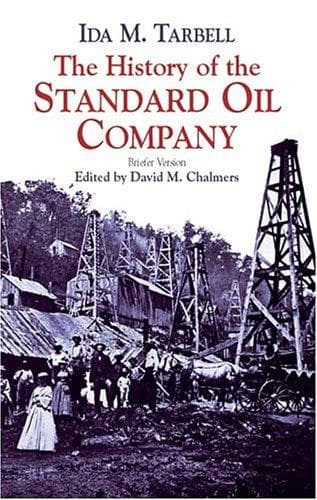
The History of the Standard Oil CompanyTarbell, Ida M. (Ida Minerva)
History
The History of the Standard Oil Company
Tarbell, Ida M. (Ida Minerva)
Petroleum industry and trade -- United States -- History; Standard Oil Company -- History
big shippers were bent on re-establishing the principle supposed to have
been overthrown by the Oil War that one shipper is more convenient and
profitable for a road than many, and this being so, the matter of a
road’s duty as a common carrier has nothing to do with the question.[38]
This was the situation when in June, 1873, General Devereux, whom we
have met on the Lake Shore road, became president of the Atlantic and
Great Western. Now at this time Peter H. Watson, the president of the
South Improvement Company, was president of the Erie. The two at once
looked into the condition of their joint oil traffic. They found the
rebate system abolished a year before again well intrenched.
Nevertheless the Erie was not doing much business. The entire shipments
of oil over the Erie for 1873 were but 762,000 barrels out of a total of
4,963,000. Naturally they went to work to build up a trade, and their
relations being what they had been with the Standard, the company
controlling a third of the country’s refining capacity, they went to
them to see if they could not get a percentage of their seaboard
shipments from Cleveland. Mr. Rockefeller was willing to give them
shipments if they would make the rates as low as were given to any of
his competitors on any of the roads, and if they would deliver his oil
at Hunter’s Point, Brooklyn, where he had oil yards, and where the
Central delivered, or if they would not do that if they would lease
their own oil yards to him. There was an excellent business reason for
making that latter demand, which Mr. Blanchard explained to the Hepburn
Commission:
“The Standard,” said Mr. Blanchard, “had a force of men, real estate,
houses, tanks and other facilities at Hunter’s Point for receiving and
coopering the oil; and they had their cooperage materials delivered over
there. The arrangement prior to that time was that the Erie Company
performed this service for its outside refiners at Weehawken, for which
the Erie Company made specific charges and added them to their rates for
freight. The Standard Company said to us: ‘We do the business at low
cost at Hunter’s Point because we are expert oil men and know how to
handle it; we pay nobody a profit, and cannot and ought not to pay you a
profit for a service that is not transportation any more than inspecting
flour or cotton; and the New York Central delivers our oil at that
point. Now if you will deliver our oil at Hunter’s Point and permit us
to do this business, you may do so; we want to do that business, and we
cannot pay to the Erie Railway Company at Weehawken a profit on all of
those staves, heads, cooperage, filling, refilling and inspection, for
we have our own forces of men and our own yards necessary for this work
in another part of the harbour of New York; and it is not a part of your
business as a carrier, anyway.’
Public-domain text, read in full here on John Shaqi.
Reviews
Reviews
No reviews yet
Be the first to share your thoughts on this work.
Elsewhere in the archive
Join the Discussion
Join the discussion
Sign in to leave a comment or review.
Sign InorCreate an account