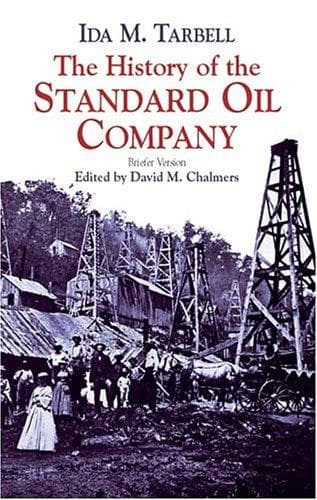
The History of the Standard Oil CompanyTarbell, Ida M. (Ida Minerva)
History
The History of the Standard Oil Company
Tarbell, Ida M. (Ida Minerva)
Petroleum industry and trade -- United States -- History; Standard Oil Company -- History
“In lieu thereof and for the profits that we could have made from the
aggregate of these charges, we said to them: ‘If you will pay us a fixed
profit upon each one of these barrels of oil arriving here, you may take
the yards and run them subject to certain limitations as to what you
shall do for other people who continue to ship oil to the same yards.’
They were only able to make this arrangement with us because of their
controlling such a large percentage of shipment, and because of
permanent facilities in Brooklyn; if the larger percentage of shipments
had belonged to outside parties, and they had had no yards of their own,
we would probably have retained the yards ourselves.”
A contract was signed on April 17, 1874. By it the Standard agreed to
ship fifty per cent. of the products of its refineries by the Erie at
rates “no higher than is paid by the competitors of the Standard Oil
Company from competing Western refineries to New York by all rail
lines,” and to give all oil patrons of the Erie system a uniform price
and fair and equal facilities at the Weehawken yards.[39] It was a very
wise business deal for both parties. It made Mr. Rockefeller the
favoured shipper of a second trunk line (the Central system was already
his) and it gave him the control of that road’s oil terminal so that he
could know exactly what other oil patrons of the road were doing—one of
the advantages the South Improvement contract looked out for, it will be
remembered. As for the Erie, it tied up to them an important trade and
again put them into a position to have something to say about the
division of the oil traffic, the bulk of which outside of the Standard
Oil Company the Pennsylvania was handling. In connection with the
Central the Erie now said to the Pennsylvania that henceforth they
proposed to maintain their position as oil shippers.
The natural result of the determination of the Central and Erie to get
from the Pennsylvania a percentage of its freight was, of course,
increased cutting, and it looked as if a rate war was inevitable. At
this juncture Colonel Potts of the Empire Transportation Company,
handling all of the Pennsylvania freight, suggested to his rivals that
it would be a favourable time for the three trunk lines to pool their
seaboard oil freight. In the discussions of this proposition, which, of
course, involved a new schedule of rates, there being now practically
none, it was suggested that henceforth freights be so adjusted that they
would be equal to all refiners, on crude and refined from all points.
Such an equalisation seems at first glance an unsolvable puzzle. The
agents found it intricate enough. Throughout the summer of 1874 they
worked on it, holding meetings at Long Branch and Saratoga and calling
into their counsels a few of the leading refiners, pipe-line men and
producers whom they could trust to keep quiet about the project.
Public-domain text, read in full here on John Shaqi.
Reviews
Reviews
No reviews yet
Be the first to share your thoughts on this work.
Elsewhere in the archive
Join the Discussion
Join the discussion
Sign in to leave a comment or review.
Sign InorCreate an account