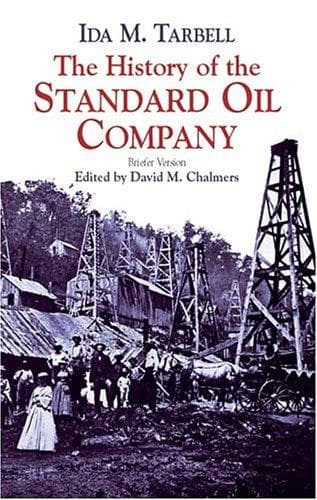
The History of the Standard Oil CompanyTarbell, Ida M. (Ida Minerva)
History
The History of the Standard Oil Company
Tarbell, Ida M. (Ida Minerva)
Petroleum industry and trade -- United States -- History; Standard Oil Company -- History
By the first of September they had an agreement worked out by which each
of the three roads was to have a fixed percentage of Eastern shipments.
The rates to the seaboard were to amount to the same for all refiners
wherever located. That is, to use one of the illustrations employed by
Mr. Blanchard in explaining the scheme to the Hepburn Commission:
“Suppose 100 barrels of refined oil to have been sent from Cleveland to
New York by rail; the consignee was required to first pay freight
therefor at New York upon delivery $1.90; to make this quantity of
refined oil at that time, he had already paid freight on say 133½
barrels of crude oil from the pipes to Cleveland at thirty-five cents
per barrel or say $46.67; he had therefore paid out from the pipes to
the refinery and thence to New York by transportation only, on 100
barrels refined and the quantity of crude oil required to make it,
$236.67 or $2.37 per barrel; therefore, at the end of the month we
refunded the $46.67 already paid on the crude oil. So that the rate paid
net was $1.90 to him and all other refiners.”
[Illustration:
FLEET OF OIL BOATS AT OIL CITY IN 1864
]
In case of the refineries situated at the seaboard the cost of carrying
from the Oil Regions the 133½ barrels of crude oil required to make 100
barrels of refined was made exactly the same as carrying the 100 barrels
of refined made in the West and transported East. This really amounted
to charging nothing for getting the crude oil to a refinery wherever it
was situated, as the following clause in the agreement shows: “The roads
transporting the refined oil shall refund to the refiners as a drawback
the charges paid by them upon the crude oil reaching their refineries by
rail.” This paragraph provided for this crude rebate contained a second
clause, which read: “And the roads transporting through crude oil to the
Eastern seaboard shall refund to the shippers twenty-two cents per
barrel; both of said drawbacks to be paid only on oil reaching the
initial points of rail shipment, through pipes, the owners of which
maintain agreed rates of pipage.” The paragraph announced two new and
startling intentions on the part of the oil-carrying roads: first, that
they intended to strip the Oil Regions of the advantage of geographical
position at the wells by sending oil free to Cleveland and Pittsburg,
New York and Philadelphia, at the same time leaving these cities the
advantages accruing from their position as manufacturing centres and
close to domestic markets; second, that they had entered into a
combination with certain pipe-lines to drive certain others out of
existence.
Public-domain text, read in full here on John Shaqi.
Reviews
Reviews
No reviews yet
Be the first to share your thoughts on this work.
Elsewhere in the archive
Join the Discussion
Join the discussion
Sign in to leave a comment or review.
Sign InorCreate an account