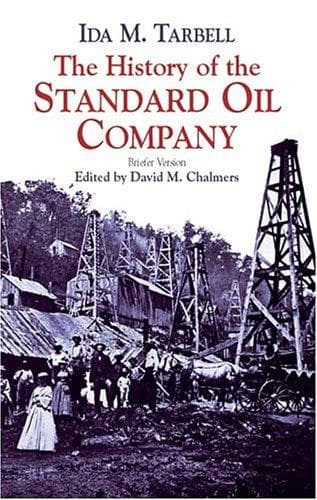
The History of the Standard Oil CompanyTarbell, Ida M. (Ida Minerva)
History
The History of the Standard Oil Company
Tarbell, Ida M. (Ida Minerva)
Petroleum industry and trade -- United States -- History; Standard Oil Company -- History
Mr. Blanchard gave the reasons of these two revolutionary moves to the
Hepburn Committee. It was “urgently represented to the trunk lines,” he
said, “by some refiners at the West as well as by others at the
seaboard, and also by crude shippers and receivers and by owners of
pipe-lines, that it was in every way desirable that the refiners of
Cleveland and Pittsburg, and those at the seaboard be put upon a basis
of equalisation in the gross rates of transportation to and from the
refineries.” Now to do this the element of distance had to be
disregarded. Cleveland was 150 miles west of the Oil Regions, but she
must be treated as if she were at the same distance from the seaboard.
As soon as the proposition was made, certain of the refiners and
producers objected unless the railroads went further and equalised rates
on coal, acids, cooperage, etc. This, however, the roads declined to do.
As for the second clause—the rebate on all oil coming from pipes which
kept up a fixed pipage—it came about in this way. While the railroad men
were in conference at Long Branch, Henry Harley, the president of the
Pennsylvania Transportation Company, came to them and said that he
believed the scheme of equalisation could not be carried out unless some
kind of an alliance was made with the pipe-lines. There had been a large
increase in the number of pipes in the four or five years preceding, and
a situation had arisen not unlike that in every other branch of the oil
business. There was perhaps twice the pipe capacity needed for gathering
all the oil produced, and as the pipes were under at least a dozen
different managements, each fighting for business, the result was, of
course, just what it had been on the railroads and in the markets—severe
cutting of prices, rebates, special secret arrangements, confusion and
loss. It had been only nine years since the first pipe-line had been a
success, and considering the phenomenal growth of the business and the
important part the pipe played in it, it was of course a situation
natural enough. Like the overgrowth of refining and of production, it
was something only time and solidification of business could remedy.
Public-domain text, read in full here on John Shaqi.
Reviews
Reviews
No reviews yet
Be the first to share your thoughts on this work.
Elsewhere in the archive
Join the Discussion
Join the discussion
Sign in to leave a comment or review.
Sign InorCreate an account