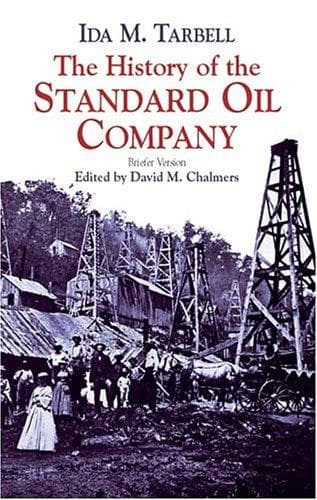
The History of the Standard Oil CompanyTarbell, Ida M. (Ida Minerva)
History
The History of the Standard Oil Company
Tarbell, Ida M. (Ida Minerva)
Petroleum industry and trade -- United States -- History; Standard Oil Company -- History
With all these reflections fresh in mind, Mr. Rockefeller again bent
over a map of the refining interests of the United States. Here was the
world he sighed to conquer. If we may suppose him to have begun his
campaign as a great general with whom he has many traits in common—the
First Napoleon—used to begin his, by studding a map with red-headed pegs
marking the points he must capture, Mr. Rockefeller’s chart would have
shown in and around Boston perhaps three pegs, representing a crude
capacity of 3,500 barrels; in and around New York fifteen pegs, a
capacity of 9,790 barrels; in and around Philadelphia twelve pegs, a
capacity of 2,061 barrels; in Pittsburg twenty-two pegs, a capacity of
6,090 barrels; on the creek twenty-seven pegs, a capacity of 9,231
barrels.[42] His work was to get control of this multitude of red pegs
and to fly above them the flag of what the irreverent call the “holy
blue barrel.”[43]
Some time in the summer of 1874, after it had become certain that
Colonel Potts’s plan for an equalisation of oil freights would be
carried out, Mr. Rockefeller wrote to his former colleague in the South
Improvement Company, W. G. Warden, of Philadelphia, telling him he
wanted to talk over the condition of the oil business with him, and
inviting him to bring Charles Lockhart, of Pittsburg, to that Mecca of
American schemers, Saratoga, for a conference with him and Mr. Flagler.
Mr. Warden hesitated. He had been much abused for his relation with the
South Improvement Company. He had seen the National Refiners’
Association fail. He had begun to feel a distaste for combination.
Besides, he was doing very well in Philadelphia. However, after some
hesitation, he and Mr. Lockhart went to Saratoga. The four gentlemen
breakfasted together and later strolled out to a pavilion. Here they
discussed again, as they had nearly three years before, when they
prepared the South Improvement assault, the condition of the oil
business.
[Illustration:
GEORGE H. BISSELL
Founder of the first oil company in the United States.
]
[Illustration:
JONATHAN WATSON
One of the owners of the land on which the first successful well was
drilled for oil.
]
[Illustration:
SAMUEL KIER
The first petroleum refined and sold for lighting purpose was made by
Mr. Kier in the ’50s in Pittsburg.
]
[Illustration:
JOSHUA MERRILL
The chemist and refiner to whom many of the most important processes
now in use in making illuminating and lubricating oils are due.
]
Public-domain text, read in full here on John Shaqi.
Reviews
Reviews
No reviews yet
Be the first to share your thoughts on this work.
Elsewhere in the archive
Join the Discussion
Join the discussion
Sign in to leave a comment or review.
Sign InorCreate an account