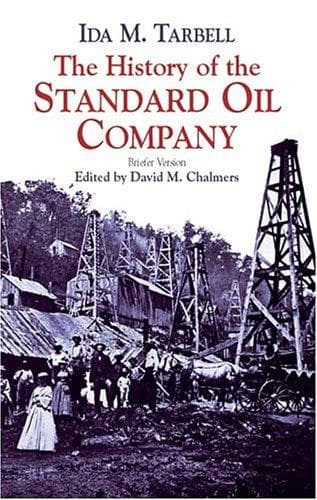
The History of the Standard Oil CompanyTarbell, Ida M. (Ida Minerva)
History
The History of the Standard Oil Company
Tarbell, Ida M. (Ida Minerva)
Petroleum industry and trade -- United States -- History; Standard Oil Company -- History
Mr. Rockefeller now had something besides a theory to present to the
gentlemen he wished to go into his third scheme. He had the most
persuasive of all arguments—an actual achievement. “Three years ago,” he
could tell them, “I took over the Cleveland refineries. I have managed
them so that to-day I pay a profit to nobody. I do my own buying, I make
my own acid and barrels, I control the New York terminals of both the
Erie and Central roads, and ship such quantities that the railroads give
me better rates than they do any other shipper. In 1873 I shipped over
700,000 barrels by the Central, and my profit on my capitalisation,
$2,500,000, was over $1,000,000. This is the result of combination in
one city. The railroads now have arranged a new tariff, by which they
mean to put us all on an equal footing. They say they will give no
rebates to anyone, but if we can join with Cleveland the strongest
forces in other great shipping points, and apply to them the same
tactics I have employed, we shall become the largest shipper, and can
demand a rebate in return for an equal division of our freight. We
proved in 1872–1873 that we could not do anything by an open
association. Let us who see what a combination strictly carried out will
effect unite secretly to accomplish it. Let us become the nucleus of a
_private_ company which gradually shall acquire control of all
refineries everywhere, become the only shippers, and consequently the
master of the railroads in the matter of freight rates.” It was six
hours before the gentlemen in conference left the pavilion, and when
they came out Mr. Warden and Mr. Lockhart had agreed to transfer their
refineries in Philadelphia and Pittsburg to the Standard Oil Company, of
Cleveland, taking stock in exchange. They had also agreed to absorb, as
rapidly as persuasion or other means could bring it about, the
refineries in their neighbourhood. Their union with the Standard was to
remain an absolute secret—the concerns operating under their respective
names.[44]
On October 15, 1874, Mr. Rockefeller consummated another purchase of as
great importance. He bought the works of Charles Pratt and Company, of
New York city. As before, the purchase was secret. The strategic
importance of these purchases for one holding Mr. Rockefeller’s vast
ambition was enormous. It gave him as allies men who were among the most
successful refiners, without doubt, in each of the three greatest
refining centres of the country outside of Cleveland, where he ruled,
and of the creek, where he had learned that neither he nor any member of
the South Improvement Company could do business with facility. To meet
these purchases the stock of the Standard Oil Company was increased, on
March 10, 1875, to $3,500,000.[45] The value of the concern as a
money-earner at this early date, 1874, is shown by the fact that Pratt
and Company paid not less than $265 for the Standard stock they received
in exchange for their works.[46]
Public-domain text, read in full here on John Shaqi.
Reviews
Reviews
No reviews yet
Be the first to share your thoughts on this work.
Elsewhere in the archive
Join the Discussion
Join the discussion
Sign in to leave a comment or review.
Sign InorCreate an account