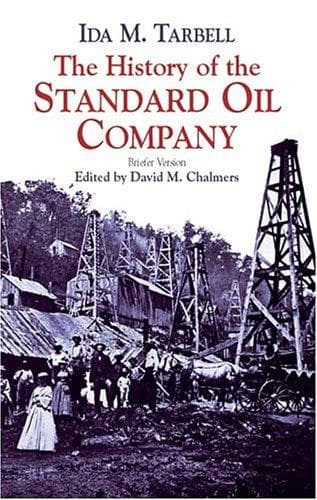
The History of the Standard Oil CompanyTarbell, Ida M. (Ida Minerva)
History
The History of the Standard Oil Company
Tarbell, Ida M. (Ida Minerva)
Petroleum industry and trade -- United States -- History; Standard Oil Company -- History
The first intimation that the Oil Region had that Mr. Rockefeller was
pushing another combination was in March of 1875, when it was announced
that an organisation of refiners, called the Central Association, of
which he was president, had been formed. Its main points were that if a
refiner would lease to the association his plant for a term of months he
would be allowed to subscribe for stock of the new company. The lease
allowed the owner to do his own manufacturing, but gave Mr.
Rockefeller’s company “irrevocable authority” to make all purchases of
crude oil and sales of refined, to decide how much each refinery should
manufacture, and _to negotiate for all freight and pipe-line expenses_.
The Central Association was a most clever device. It furnished the
secret partners of Mr. Rockefeller a plausible proposition with which to
approach the firms of which they wished to obtain control.
Little as the Oil Regions knew of the real meaning of the Central
Association, the news of its organisation raised a cry of monopoly, and
the advocates of the new scheme felt called upon to defend it. The
defense took the line that the conditions of the trade made such a
combination of refineries necessary. Altogether the ablest explanation
was that of H. H. Rogers, of Charles Pratt and Company, to a reporter of
the New York Tribune:
“There are five refining points in the country,” said Mr. Rogers,
“Pittsburg, Philadelphia, Cleveland, the Oil Regions and New York
city. Each of these has certain local advantages which may be
briefly stated as follows: Pittsburg, cheap oil; Philadelphia, the
seaboard; Cleveland, cheap barrels, and canal as well as railroad
transportation; the Oil Regions, crude oil at the lowest figure; and
all the products of petroleum have the best market in New York city.
The supply of oil is three or four times greater than the
demand.[47] If the oil refineries were run to their full capacity,
the market would be overstocked. The business is not regular, but
spasmodic. When the market is brisk and oil is in demand, all the
oil interests are busy and enjoy a fair share of prosperity. At
other times, the whole trade is affected by the dullness. It has
been estimated that not less than twenty millions of dollars are
invested in the oil business. It is therefore to the interest of
every man who has put a dollar in it to have the trade protected and
established on a permanent footing. Speculators have ruined the
market. The brokers heretofore have been speculating upon the market
with disastrous effects upon the trade, and this new order of things
will force them to pursue their legitimate calling, and realise
their profits from their industry and perseverance. Two years ago an
attempt was made to organise an oil refiners’ association, but it
was subsequently abandoned. There was no cohesion of interests, and
agreements were not kept. The movement at the present time is a
Public-domain text, read in full here on John Shaqi.
Reviews
Reviews
No reviews yet
Be the first to share your thoughts on this work.
Elsewhere in the archive
Join the Discussion
Join the discussion
Sign in to leave a comment or review.
Sign InorCreate an account