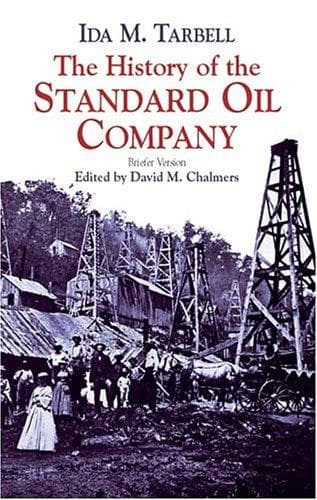
The History of the Standard Oil CompanyTarbell, Ida M. (Ida Minerva)
History
The History of the Standard Oil Company
Tarbell, Ida M. (Ida Minerva)
Petroleum industry and trade -- United States -- History; Standard Oil Company -- History
revival of the former idea, and, it is believed, has already secured
fully nine-tenths of the oil refiners in the country in its favour.
I do not believe there is any intention among the oil men to ‘bull’
the market. The endeavour is to equalise all around and protect the
capital invested. If by common consent, in good faith, the refiners
agree to reduce the quantities to an allotment for each, made in
view of the supply and demand, and the capacity for production, the
market can be regulated with a reasonable profit for all. The price
of oil to-day is fifteen cents per gallon. The proposed allotment of
business would probably advance the price to twenty cents. To make
an artificial increase, with immense profits, would be recognised as
speculative instead of legitimate, and the oil interests would
suffer accordingly. Temporary capital would compete with permanent
investment and ruin everything. The oil producers to-day are
bankrupt. There have been more failures during the last five months
than in five years previously. An organisation to protect the oil
capital is imperatively needed. Oil to yield a fair profit should be
sold for twenty-five cents per gallon. That price would protect
every interest and cover every outlay for getting out the crude
petroleum, transporting by railroad, refining and the incidental
charges of handling, etc. The foreign markets will regulate the
price to a great extent, because they are the greatest consumers.
The people of China, Germany, and other foreign countries cannot
afford to pay high prices. Kerosene oil is a luxury to them, and
they do not receive sufficient compensation for their labour to
enable them to use this oil at an extravagant price. The price,
therefore, must be kept within reasonable limits.”
The Oil Regions refused flatly to accept this view of the situation. The
world would not buy refined at twenty-five cents, they argued. “You
injured the foreign market in 1872 by putting up the price. Our only
hope is in increasing consumption. The world is buying more oil to-day
than ever before, because it is cheap. We must learn to accept small
profits, as other industries do.” “The formation of the Refiners’
Association has thrust upon the trade an element of uncertainty that has
unsettled all sound views as to the general outlook,” said the Derrick.
“The scope of the Association,” wrote a Pittsburg critic, “is an attempt
to control the refining of oil, with the ultimate purpose of advancing
its price and reaping a rich harvest in profits. This can only be done
by reducing the production of refined oil, and this will in turn act on
crude oil, making the stock so far in excess of the demand as to send it
down to a lower figure than it has yet touched.”
Public-domain text, read in full here on John Shaqi.
Reviews
Reviews
No reviews yet
Be the first to share your thoughts on this work.
Elsewhere in the archive
Join the Discussion
Join the discussion
Sign in to leave a comment or review.
Sign InorCreate an account