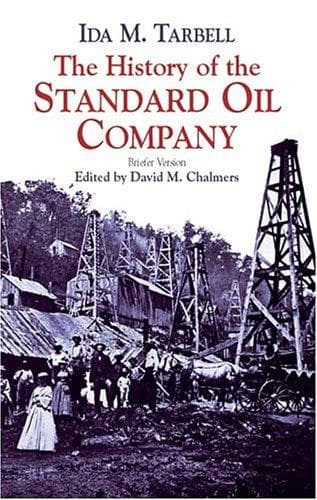
The History of the Standard Oil CompanyTarbell, Ida M. (Ida Minerva)
History
The History of the Standard Oil Company
Tarbell, Ida M. (Ida Minerva)
Petroleum industry and trade -- United States -- History; Standard Oil Company -- History
“The most important feature of this contract,” said a “veteran refiner,”
“is perhaps that part which provides that the Executive Committee of the
Central Association are to have the exclusive power to arrange with the
railroads for the carrying of the crude and refined oil. It is intended
by this provision to enable the Executive Committee to speak for the
whole trade in securing special rates of freight, whereby independent
shippers of crude oil, and such refiners as refuse to join the
combination, and any new refining interest that may be started, may be
driven out of the trade. The whole general purpose of the combination is
to reap a large margin by depressing crude and raising the price of
refined oil, and the chief means employed is the system of
discrimination in railroad freights to the seaboard.”
“The veteran refiner” was right in his supposition that Mr. Rockefeller
intended to use the enormous power his combination gave him to get a
special rate. As a matter of fact he had seen to that before the
“veteran refiner” expressed his mind. It will be remembered that in
April, 1874, Mr. Rockefeller had made a contract with the Erie by which
he was to ship fifty per cent. of his refined oil over that road at a
rate as low as any competing line gave any shipper and he was to have a
lease of the Weehawken oil terminal. Now this contract remained in force
until the first of March, 1875, when a new one was made with the Erie
guaranteeing the road the same percentage of freight and giving the
Standard a ten per cent. rebate on whatever open tariff should be fixed.
This rebate Mr. Blanchard says was quite independent of what the Central
might be giving the Standard. He says that one reason the Standard was
given the rebate was that it was suspected the Pennsylvania was allowing
the Empire Transportation Company an even larger one. If true, this
would not affect any refiner necessarily as the Empire was not a refiner
in March, 1875. The real reason, of course, was what Mr. Blanchard gives
later—that by this rebate they kept the Standard trade, now greatly
increased by the purchase of the outside works already mentioned,
although it should be noticed the Erie officials knew nothing of the
Standard having control of any other refinery than that of Charles Pratt
and Company.
Public-domain text, read in full here on John Shaqi.
Reviews
Reviews
No reviews yet
Be the first to share your thoughts on this work.
Elsewhere in the archive
Join the Discussion
Join the discussion
Sign in to leave a comment or review.
Sign InorCreate an account