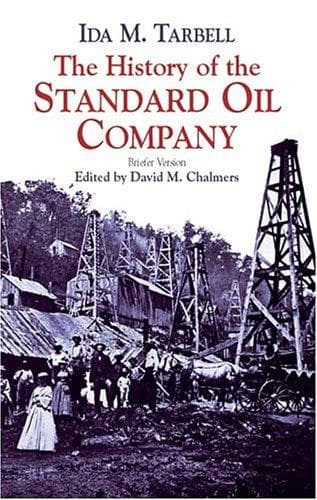
The History of the Standard Oil CompanyTarbell, Ida M. (Ida Minerva)
History
The History of the Standard Oil Company
Tarbell, Ida M. (Ida Minerva)
Petroleum industry and trade -- United States -- History; Standard Oil Company -- History
Frank Rockefeller gave a pretty complete story of the trials of an
independent refiner in Cleveland during the preceding four years. His
testimony in regard to the South Improvement Company has already been
quoted. He declared that at the moment, his concern, the Pioneer Oil
Company, was unable to get the same rates as the Standard; the freight
agent frankly told him that unless he could give the road the same
amount of oil to transport that the Standard did he could not give the
rate the Standard enjoyed. Mr. Rockefeller said that in his belief there
was a pooling arrangement between the railroads and the Standard and
that the rebate given was “divided up between the Standard Oil Company
and the railroad officials.” He repeatedly declared to the committee
that he did not know this to be a positive fact, that he had no proof,
but that he believed such was the truth. Among the railroad officials
whom he mentioned as in his opinion enjoying spoils were W. H.
Vanderbilt, Thomas Scott and General Devereux. Of course the newspapers
had it that he had sworn that such was the fact. Colonel Scott promptly
wired the following denial:
“The papers of this morning publish that a man named Rockefeller
stated before your committee that myself and other officers of this
company were participants in rebates made to the Standard Oil
Company. So far as the statement relates to myself and the officers
of this company it is unqualifiedly false, and I have to ask that
you will summon the officers of the Standard Oil Company, or any
other parties that may have any knowledge of that subject, in order
that such villainous and unwarranted statements may be corrected.”
General Devereux published in the Cleveland press an equally emphatic
denial. Although Mr. Rockefeller promptly declared that he had stated to
the committee that he had no personal knowledge that there was such a
pool as he had intimated between the railroad men and the Standard, that
he had only given his suspicions, there were plenty of people to
overlook his explanation and assert that he had given proof of such a
division of spoils. The belief spread and is met even to-day in oil
circles. Now the only basis for any such assertion was the fact that W.
H. Vanderbilt, Peter H. Watson and Amasa Stone were at that time, 1876,
stockholders in the Standard Oil Company. There is no evidence of which
the writer knows that General Devereux or Colonel Scott ever held any
stock in the concern. Indeed, in 1879, when A. J. Cassatt was under
examination as to the relations of the Pennsylvania Railroad and the
Standard Oil Company, his own lawyer took pains to question him on this
point—an effort, no doubt, to silence the accusation which at that date
was constantly repeated.
Public-domain text, read in full here on John Shaqi.
Reviews
Reviews
No reviews yet
Be the first to share your thoughts on this work.
Elsewhere in the archive
Join the Discussion
Join the discussion
Sign in to leave a comment or review.
Sign InorCreate an account