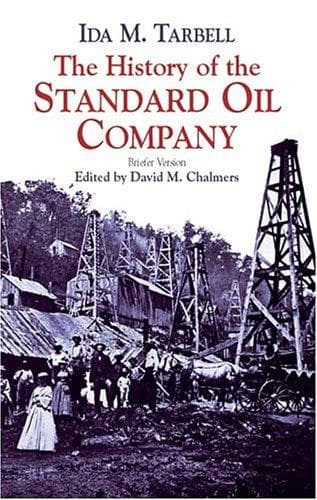
The History of the Standard Oil CompanyTarbell, Ida M. (Ida Minerva)
History
The History of the Standard Oil Company
Tarbell, Ida M. (Ida Minerva)
Petroleum industry and trade -- United States -- History; Standard Oil Company -- History
“Mr. Cassatt,” Mr. MacVeagh said, “I want to direct your attention
to a personal matter which was asked you to a certain extent. You
were asked whether you had any knowledge that Mr. Vanderbilt,
representing the New York Central, or Mr. Jewett, representing the
Erie, had any interest whatever in the Standard Oil Company or any
of its affiliated companies. I wish to extend that question to the
other trunk lines. I wish you would state whether or not to your
knowledge Mr. Garrett, or anybody representing the Baltimore and
Ohio, had any such interest?”
“They have not to my knowledge.”
* * * * *
“Then I wish you would state whether Mr. Scott or yourself, or any
other officers of the Pennsylvania Railroad Company, had any such
interest?”
“Never to my knowledge. I speak of absolute knowledge as to myself,
but as to Mr. Scott to the best of my knowledge and belief.”
Of course after this controversy the railroads were more obdurate than
ever. Mr. Payne and Mr. Camden were active, too, in securing the
suppression of the investigations and they soon succeeded not only in
doing that but in pigeon-holing for the time Mr. Hopkins’s Interstate
Commerce Bill.
But the oil men had not been trusting entirely to Congressional relief.
From the time that they became convinced that the railroads meant to
stand by the terms of the “Rutter Circular” they began to seek an
independent outlet to the sea. The first project to attract attention
was the Columbia Conduit Pipe Line. This line was begun by one of the
picturesque characters of Western Pennsylvania, “Dr.” David Hostetter,
the maker of the famous Hostetter’s Bitters. Dr. Hostetter’s Bitters’
headquarters were in Pittsburg. He had become interested in oil there,
and had made investments in Butler County. In 1874 he found himself
hampered in disposing of his oil and conceived the idea of piping it to
Pittsburg, where he could make a connection with the Baltimore and Ohio
road, which up to this time had refused to go into the oil pool. Now at
that time the right of eminent domain for pipes had been granted in but
eight counties of Western Pennsylvania. Allegheny County, in which
Pittsburg is located, was not included in the eight, a restriction which
the oil men attributed rightly, no doubt, to the influence of the
Pennsylvania Railroad in the State Legislature. That road could hardly
have been expected to allow the pipes to go to Pittsburg and connect
with a rival road if it could help it. Dr. Hostetter succeeded in buying
a right of way through the county, however, and laid his pipes within a
few miles of the city to a point where he had to pass under a branch of
the Pennsylvania Railroad. The spot chosen was the bed of a stream over
which the railroad passed by a bridge. Dr. Hostetter claimed he had
bought the bed of the run and that the railroad owned simply the right
to span the run.
Public-domain text, read in full here on John Shaqi.
Reviews
Reviews
No reviews yet
Be the first to share your thoughts on this work.
Elsewhere in the archive
Join the Discussion
Join the discussion
Sign in to leave a comment or review.
Sign InorCreate an account