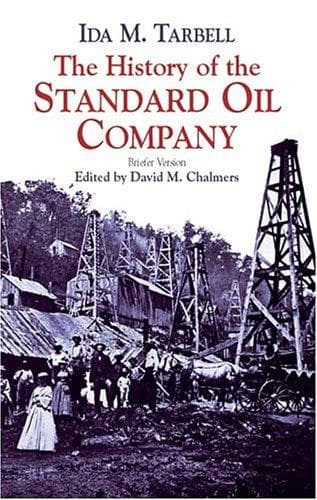
The History of the Standard Oil CompanyTarbell, Ida M. (Ida Minerva)
History
The History of the Standard Oil Company
Tarbell, Ida M. (Ida Minerva)
Petroleum industry and trade -- United States -- History; Standard Oil Company -- History
Of course refined oil went up steadily with crude. Refined reached 21⅜
cents in New York the day of this boom at Oil City. The day following
the rise was one of the most exciting the oil exchange had ever seen.
“Never before,” declared the Derrick in its report, “was so much
business done.” From early in the morning until ten o’clock at night the
exchange was crowded by frantic speculators. Their awful excitement was
clear from their blanched faces and wild voices. Fully 800,000 barrels
of oil exchanged hands that day, the advance between the time the
exchange opened and its close was over fifty-five cents. Refined in New
York advanced in accordance with the market on the creek, closing at
twenty-four cents. This went on for several days, when a new element in
the situation began to force itself on the oil men’s attention. One of
the chief reasons on which they based their confidence in high prices
for crude oil was the fact that the foreigners were short of refined
oil. It was the custom then, as now, for exporters to buy their oil for
the winter European trade in the late summer and early fall. When the
boom began the harbour at New York was beginning to fill up with ships
for cargoes. But to the consternation of the oil men intent on keeping
up the boom, the exporters were refusing to buy. They were declaring the
price to which refined had risen to be out of proportion to the price of
crude. More, they declared the latter a speculative price—only once,
they argued, had it touched four dollars, and the refiners were not
buying at that price for manufacture. They were holding refined too
high. It was early in September when the realisation came upon the Oil
Regions that a new element was in the problem—a veritable blockade in
exports. As the days went on they saw that this was no temporary affair.
They saw that Mr. Rockefeller’s combination was at last carrying out
just what it had been organised to do—forcing the price it wanted for
refined. Day after day refined was held at twenty-six cents. Day after
day the exporters refused to buy. It was not until the end of September,
in fact, that they began to yield—as it was inevitable they should do,
for the game was certainly in the hands of the refiners, and Europe had
to have its light. The exporters began to see too that if they held off
longer they might have to pay higher prices, for it was rumoured that
the Standard Combination was shutting down its factories, literally
making refined scarce, while crude oil was piling up in Pennsylvania!
Public-domain text, read in full here on John Shaqi.
Reviews
Reviews
No reviews yet
Be the first to share your thoughts on this work.
Elsewhere in the archive
Join the Discussion
Join the discussion
Sign in to leave a comment or review.
Sign InorCreate an account