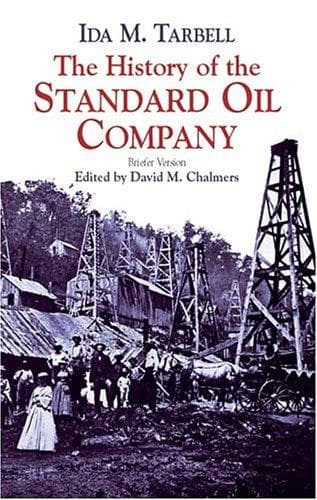
The History of the Standard Oil CompanyTarbell, Ida M. (Ida Minerva)
History
The History of the Standard Oil Company
Tarbell, Ida M. (Ida Minerva)
Petroleum industry and trade -- United States -- History; Standard Oil Company -- History
To determine what products might be obtained in the oil, a portion
of it was submitted to fractional distillation.[82] The temperature
of the fluid was constantly regulated by a thermometer, the heat
being applied first by a water bath, and then by a bath of linseed
oil. This experiment was founded upon the belief that the crude
product contained several distinct oils, having different boiling
points. The quantity of material used in this experiment was 304
grammes. The thermometer indicated the degrees of the Centigrade
scale, but, for convenience, the corresponding degrees of
Fahrenheit’s scale are added. The water bath failed to distil any
portion of the oil at 100° C. (= 212° F.), only a small quantity of
acid water came over. An oil bath, linseed oil, was then
substituted, and the temperature was regularly raised by slow
degrees until distillation commenced. From that point the heat was
successively raised by stages of ten degrees, allowing full time at
each stage for complete distillation of all that would rise at that
temperature before advancing to the next stage. The results of this
tedious process are given in the annexed table—304 grammes of crude
oil, submitted to fractional distillation, gave
TEMPERATURE QUANTITY
1st Prod. at 100° C. = 213° F.(acid water) 5 gms.
2nd Prod. at 140° C. to 150° C.= 284° to 302° F. 26 gms.
3rd Prod. at 150° C. to 160° C.= 302° to 320° F. 29 gms.
4th Prod. at 160° C. to 170° C.= 320° to 388° F. 38 gms.
5th Prod. at 170° C. to 180° C.= 338° to 367° F. 17 gms.
6th Prod. at 180° C. to 200° C.= 356° to 392° F. 16 gms.
7th Prod. at 200° C. to 220° C.= 392° to 428° F. 17 gms.
8th Prod. at 220° C. to 270° C.= 428° to 518° F. 12 gms.
Whole quantity distilled by this method 160 gms.
———
Leaving residue in the retort 144 gms.
———
Original quantity 304 gms.
_Product No. 1_, as above remarked, was almost entirely water, with
a few drops of colourless oil, having an odour similar to the
original fluid, but less intense.
_Product No. 2_ was an oil perfectly colourless, very thin and
limpid, and having an exceedingly persistent odour, similar to the
crude oil, but less intense.
_Product No. 3_ was tinged slightly yellow, perfectly transparent,
and apparently as limpid as the second product, with the same odour.
_Product No. 4_ was more decidedly yellowish than the last, but was
in no other respect distinguishable from it.
_Product No. 5_ was more highly coloured, thicker in consistence,
and had a decided empyreumatic odour.
Public-domain text, read in full here on John Shaqi.
Reviews
Reviews
No reviews yet
Be the first to share your thoughts on this work.
Elsewhere in the archive
Join the Discussion
Join the discussion
Sign in to leave a comment or review.
Sign InorCreate an account