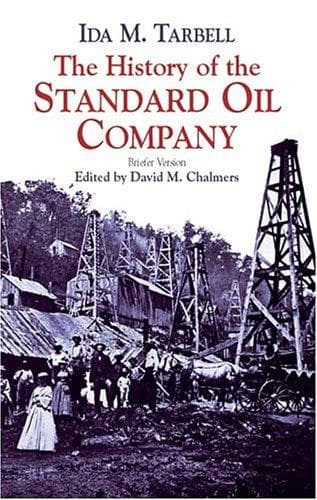
The History of the Standard Oil CompanyTarbell, Ida M. (Ida Minerva)
History
The History of the Standard Oil Company
Tarbell, Ida M. (Ida Minerva)
Petroleum industry and trade -- United States -- History; Standard Oil Company -- History
It is safe to add that, by the original distillation, about 50 per
cent. of the crude oil is obtained in a state fit for use as an
illuminator without further preparation than simple clarification by
boiling a short time with water.
DISTILLATION BY HIGH STEAM
Bearing in mind that by aid of high steam, at an elevated
temperature, many distillations in the arts are affected which
cannot be so well accomplished by dry heat, I thought to apply this
method in case of the present research. Instances of this mode of
distillation are in the new process for Stearine candles, and in the
preparation of rosin oil. I accordingly arranged my retort in such a
manner that I could admit a jet of high steam into the boiler, and
almost at the bottom of the contained petroleum. I was, however,
unable to command a jet of steam above 275° to 290° F., and although
this produced abundant distillation, it did not effect a separation
of the several products, and the fluid distilled had much the same
appearance as the petroleum itself, thick and turbid. As this trial
was made late in the investigation, I have been unable to give it a
satisfactory issue, chiefly for want of steam of a proper
temperature. But I suggest, for the consideration of the company,
the propriety of availing themselves of the experience already
existing on this subject, and particularly among those who are
concerned in the distillation of rosin oil—a product having many
analogies with petroleum in respect to its manufacture.
USE OF THE NAPHTHA FOR ILLUMINATION
Many fruitless experiments have been made in the course of this
investigation which it is needless to recount. I will, therefore,
only state those results which are of value.
1. I have found that the only lamp in which this oil can be
successfully burned is the camphene lamp, or one having a button to
form the flame, and an external cone to direct the current of air,
as is now usual in all lamps designed to burn either camphene, rosin
oil, sylvic oil, or any other similar product.
2. As the distilled products of petroleum are nearly or quite
insoluble in alcohol, burning fluid (i. e., a solution of the oil in
alcohol) cannot be manufactured from it.
3. As a consequence, the oil cannot be burned in a hand lamp, since,
with an unprotected wick, it smokes badly. Neither can it be burned
in a Carcel’s mechanical lamp, because a portion of the oil being
more volatile than the rest, rises in vapour on the elevated wick
required in that lamp, and so causes it to smoke.
Public-domain text, read in full here on John Shaqi.
Reviews
Reviews
No reviews yet
Be the first to share your thoughts on this work.
Elsewhere in the archive
Join the Discussion
Join the discussion
Sign in to leave a comment or review.
Sign InorCreate an account