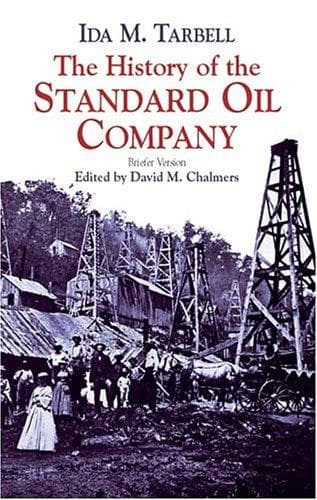
The History of the Standard Oil CompanyTarbell, Ida M. (Ida Minerva)
History
The History of the Standard Oil Company
Tarbell, Ida M. (Ida Minerva)
Petroleum industry and trade -- United States -- History; Standard Oil Company -- History
I have found all the products of distillation from the copper still
capable of burning well in the camphene lamp, except the last third
or fourth part (i.e., that portion which came off at 700° F. and
rising, and which was thick with the crystals of paraffine). Freed
from acidity by boiling on water, the oils of this distillation
burned for twelve hours without injuriously coating the wick, and
without smoke. The wick may be elevated considerably above the level
required for camphene, without any danger of smoking, and the oil
shows no signs of crusting the wick tubes with a coating of rosin,
such as happens in the case of camphene, and occasions so much
inconvenience. The light from the rectified naphtha is pure and
white, without odour. The rate of consumption is less than half that
of camphene, or rosin oil. The Imperial pint, of 20 fluid ounces,
was the one employed—a gallon contains 160 such ounces. A camphene
lamp, with a wick one inch thick, consumed of rectified naphtha in
one hour, 1¾ ounces of fluid. A Carcel’s mechanical lamp of ⅞–inch
wick, consumed of best sperm oil, per hour, 2 ounces. A “Diamond
Light” lamp, with “sylvic oil,” and a wick 1½–inch diameter,
consumed, per hour, 4 ounces.
I have submitted the lamp burning petroleum to the inspection of the
most experienced lampists who were accessible to me, and their
testimony was, that the lamp burning this fluid gave as much light
as any which they had seen, that the oil spent more economically,
and the uniformity of the light was greater than in camphene,
burning for twelve hours without a sensible diminution, and without
smoke. I was, however, anxious to test the amount of light given,
more accurately than could be done by a comparison of opinions. With
your approbation I proceeded therefore to have constructed a
_photometer_, or apparatus for the measurement of light, upon an
improved plan. Messrs. Grunow, scientific artists of this city,
undertook to construct this apparatus, and have done so to my entire
satisfaction. This apparatus I shall describe elsewhere—its results
only are interesting here. By its means I have brought the petroleum
light into rigid comparison with the most important means of
artificial illumination. Let us briefly recapitulate the results of
these
PHOTOMETRIC EXPERIMENTS
The _unit_ adopted for comparison of intensities of illumination is
Judd’s Patent Sixes Sperm Candle.
The sperm oil used was from Edward Mott Robinson, of New Bedford—the
best winter sperm remaining fluid at 32° F. The colza oil and
Carcel’s lamps were furnished by Dardonville, lampist, Broadway, New
York. The gas used was that of the New Haven Gas Light Co., made
from best Newcastle coal, and of fair average quality.
Public-domain text, read in full here on John Shaqi.
Reviews
Reviews
No reviews yet
Be the first to share your thoughts on this work.
Elsewhere in the archive
Join the Discussion
Join the discussion
Sign in to leave a comment or review.
Sign InorCreate an account