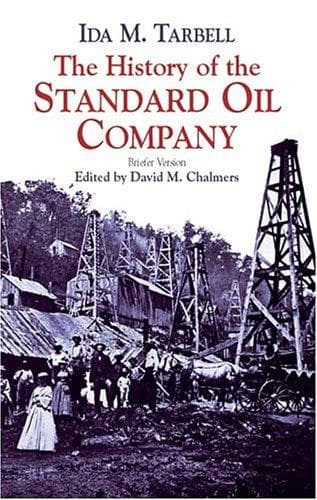
The History of the Standard Oil CompanyTarbell, Ida M. (Ida Minerva)
History
The History of the Standard Oil Company
Tarbell, Ida M. (Ida Minerva)
Petroleum industry and trade -- United States -- History; Standard Oil Company -- History
and the benefit of the railroads without the co-operation of the
producers, and the only point we discussed was whether it should be
a combination or co-operation. I took the ground personally against
forming a combination inasmuch as the interests of the producers
were in one sense antagonistic to ours, one as the seller and the
other as the buyer. We held in argument that the producers were
abundantly able to take care of their own branch of the business if
they took care of the quantity produced. They were only liable to
depression from our production, therefore they had in their own
hands directly the power of holding the market at six or eight
dollars a barrel.
_Q._ You did not take into consideration the good of the consumers
of the country, which is by far the larger part of the population of
the country?
_A._ Yes, we did.
_Q._ You wanted to put up the price of oil?
_A._ In answer to that I will state that the producers and refiners
were both suffering under the depression that existed. The refiners
were not getting enough to pay their expenses. All we asked was a
fair refiner’s profit.
_Q._ What effect were these arrangements to have upon those who did
not come into the combination or co-operation, as you have termed
it, as to the price to be charged for transporting their oil, both
refiners and producers?
_A._ I do not think we ever took that question up.
_Q._ Were the railroad companies to charge the same increase of
freights to those who did not come into the combination that they
did to you without giving them a rebate?
_A._ Yes, sir.
_Q._ Now in case you could control the oil produced by these people
in any combination that you made, were you not to have a rebate upon
the oil?
_A._ We were not to have a rebate, we were to have a drawback.
_Q._ What is the difference between a rebate and a drawback?
_A._ There is not much difference in one sense. A rebate is made at
the time we pay our freight; a drawback is made afterward.
_Q._ That is a technical, rather than a real, difference, is it not?
_A._ I want to state it as you will find it in the contract.
_Q._ The effect was that those who did not go into the combination
could not get their oil as cheaply as you could?
_A._ No, sir; they could not; I want to explain in what relation
that occurred and why this arrangement was made. I may say that it
never entered into my head that the refineries would not all be
brought in; a fair manufacturer’s profit was all we wanted. They
were all to be brought in on equal terms, and the object of the
drawback was not to cover all the oil to be refined in this country,
but only the oil that was to be exported.
_Q._ If all had gone into the combination, then the result would not
have been to injure the producers and refiners, but to injure the
consumers of the country?
_A._ No, sir; the purpose was not to injure them.
Public-domain text, read in full here on John Shaqi.
Reviews
Reviews
No reviews yet
Be the first to share your thoughts on this work.
Elsewhere in the archive
Join the Discussion
Join the discussion
Sign in to leave a comment or review.
Sign InorCreate an account