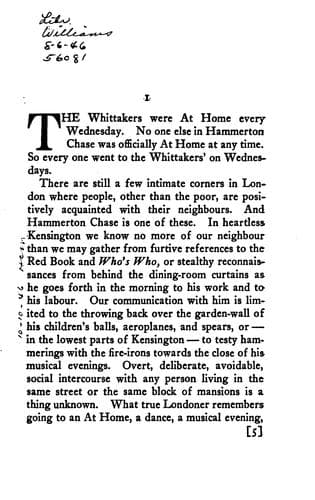
The House by the RiverHerbert, A. P. (Alan Patrick)
General
The House by the River
Herbert, A. P. (Alan Patrick)
London (England) -- Social life and customs -- 20th century -- Fiction; Murder -- Fiction; Poets -- Fiction
looked up the figure stirred sharply. Then he began to tremble with a
curious excitement, for he saw that it was Muriel herself. He dipped the
oars in the water and stopped the boat under the wall.
She said, very softly, "Mr. Byrne?"
He said, "Muriel," and his voice was no more than a whisper. But she
heard.
Then there was an intolerable silence, and they stared at each other
through the gloom; and nothing moved anywhere but the smooth, hurrying
water chuckling faintly round the boat and against the oars and along
the wall. They were silent, and their hearts beat with a guilty urgency;
and in the thoughts of both was the same riot of doubt and scruple and
exquisite excitement.
Stephen said at last,--and in his voice there was again that stealthy
hoarseness,--"Come out in the boat!"
She hesitated. She looked quickly over her shoulder at the house, which
was quite dark, because her mother and their only servant had gone early
to bed. Then without a word she came down the steps. She gave him a hot
hand that quivered in his as he helped her down. Quietly he pushed off
the boat; but on the Island a swan heard them and flew away with a
startling clatter, looking very large against the stars. Still in
silence they drifted away under the trees past the Tathams' and past the
brewery, and past the Petways' and the ferry and the church. There was
something in this silence very suggestive of wrong, making them already
confessed conspirators. Muriel somehow felt this, and said at last:
"Mother's gone to bed. I mustn't be long."
Her voice and her words and her low delightful laugh broke the spell of
self-conscious wickedness which had held them. They felt at last that
they really were in this boat with each other under the stars; it was no
fantastic dream but an amusing and, after all, quite ordinary adventure,
nothing to be ashamed of or furtive about--a gentleman and a lady
boating in the evening on the Thames.
So Stephen steered out into mid-stream and pulled more strongly now,
away past the empty meadows, and the first low houses of Barnes, and
under the big black bridge, and round the bend by the silent factories.
Then there were a few last houses, very old and dignified, and you came
out suddenly into a wide reach where there moved against the stars a
long procession of old elms, and the banks were clothed with an endless
tangle of willows and young shrubs, drooping and dipping in the water.
The tide lapped among thick reeds, and there was no murmur of London to
be heard, and no houses to be seen nor the lights of houses. It was a
corner of startling solitude, forgotten somehow in the urge of
civilization; as if none had had a heart to build a factory there or a
brewery or a wharf, but had built them resolutely to the east or to the
west and all around, determined, if they could, to spare this little
relic of the old country Thames.
Public-domain text, read in full here on John Shaqi.
Reviews
Reviews
No reviews yet
Be the first to share your thoughts on this work.
Elsewhere in the archive
Join the Discussion
Join the discussion
Sign in to leave a comment or review.
Sign InorCreate an account