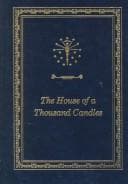
The House of a Thousand CandlesNicholson, Meredith
General
The House of a Thousand Candles
Nicholson, Meredith
Indiana -- Fiction; Inheritance and succession -- Fiction; Mystery and detective stories
My spirits quickly responded to the cheering influence
of the great library. I stirred the fire on the
hearth into life and sat down before it, tired from my
tramp. I was mystified and perplexed by the incident
that had already marked my coming. It was possible,
to be sure, that the bullet which narrowly missed my
head in the little dining-room had been a wild shot that
carried no evil intent. I dismissed at once the idea that
it might have been fired from the lake; it had crashed
through the glass with too much force to have come so
far; and, moreover, I could hardly imagine even a rifle-ball’s
finding an unimpeded right of way through so
dense a strip of wood. I found it difficult to get rid of
the idea that some one had taken a pot-shot at me.
The woman’s mocking voice from the lake added to
my perplexity. It was not, I reflected, such a voice as
one might expect to hear from a country girl; nor could
I imagine any errand that would excuse a woman’s
presence abroad on an October night whose cool air inspired
first confidences with fire and lamp. There was
something haunting in that last cry across the water;
it kept repeating itself over and over in my ears. It
was a voice of quality, of breeding and charm.
“Good night, merry gentlemen!”
In Indiana, I reflected, rustics, young or old, men or
women, were probably not greatly given to salutations
of just this temper.
Bates now appeared.
“Beg pardon, sir; but your room’s ready whenever
you wish to retire.”
I looked about in search of a clock.
“There are no timepieces in the house, Mr. Glenarm.
Your grandfather was quite opposed to them. He had
a theory, sir, that they were conducive, as he said, to
idleness. He considered that a man should work by his
conscience, sir, and not by the clock,—the one being
more exacting than the other.”
I smiled as I drew out my watch,—as much at Bates’
solemn tones and grim lean visage as at his quotation
from my grandsire. But the fellow puzzled and annoyed
me. His unobtrusive black clothes, his smoothly-brushed
hair, his shaven face, awakened an antagonism
in me.
“Bates, if you didn’t fire that shot through the window,
who did—will you answer me that?”
“Yes, sir; if I didn’t do it, it’s quite a large question
who did. I’ll grant you that, sir.”
I stared at him. He met my gaze directly without
flinching; nor was there anything insolent in his tone
or attitude. He continued:
“I didn’t do it, sir. I was in the pantry when I heard
the crash in the refectory window. The bullet came
from out of doors, as I should judge, sir.”
The facts and conclusions were undoubtedly with
Bates, and I felt that I had not acquitted myself creditably
in my effort to fix the crime on him. My abuse of
him had been tactless, to say the least, and I now tried
another line of attack.
“Of course, Bates, I was merely joking. What’s your
own theory of the matter?”
Public-domain text, read in full here on John Shaqi.
Reviews
Reviews
No reviews yet
Be the first to share your thoughts on this work.
Join the Discussion
Join the discussion
Sign in to leave a comment or review.
Sign InorCreate an account