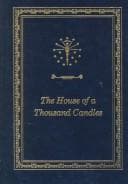
The House of a Thousand CandlesNicholson, Meredith
General
The House of a Thousand Candles
Nicholson, Meredith
Indiana -- Fiction; Inheritance and succession -- Fiction; Mystery and detective stories
“I have no theory, sir. Mr. Glenarm always warned
me against theories. He said—if you will pardon me—
there was great danger in the speculative mind.”
The man spoke with a slight Irish accent, which in
itself puzzled me. I have always been attentive to the
peculiarities of speech, and his was not the brogue of
the Irish servant class. Larry Donovan, who was English-born,
used on occasions an exaggerated Irish dialect
that was wholly different from the smooth liquid tones of
Bates. But more things than his speech were to puzzle
me in this man.
“The person in the canoe? How do you account for
her?” I asked.
“I haven’t accounted for her, sir. There’s no women
on these grounds, or any sort of person except ourselves.”
“But there are neighbors,—farmers, people of some
kind must live along the lake.”
“A few, sir; and then there’s the school quite a bit
beyond your own west wall.”
His slight reference to my proprietorship, my own
wall, as he put it, pleased me.
“Oh, yes; there is a school—girls?—yes; Mr. Pickering
mentioned it. But the girls hardly paddle on the
lake at night, at this season—hunting ducks—should
you say, Bates?”
“I don’t believe they do any shooting, Mr. Glenarm.
It’s a pretty strict school, I judge, sir, from all accounts.”
“And the teachers—they are all women?”
“They’re the Sisters of St. Agatha, I believe they call
them. I sometimes see them walking abroad. They’re
very quiet neighbors, and they go away in the summer
usually, except Sister Theresa. The school’s her regular
home, sir. And there’s the little chapel quite near the
wall; the young minister lives there; and the gardener’s
the only other man on the grounds.”
So my immediate neighbors were Protestant nuns
and school-girls, with a chaplain and gardener thrown
in for variety. Still, the chaplain might be a social resource.
There was nothing in the terms of my grandfather’s
will to prevent my cultivating the acquaintance
of a clergyman. It even occurred to me that this might
be a part of the game: my soul was to be watched over
by a rural priest, while, there being nothing else to do,
I was to give my attention to the study of architecture.
Bates, my guard and housekeeper, was brushing the
hearth with deliberate care.
“Show me my cell,” I said, rising, “and I’ll go to
bed.”
He brought from somewhere a great brass candelabrum
that held a dozen lights, and explained:
“This was Mr. Glenarm’s habit. He always used this
one to go to bed with. I’m sure he’d wish you to have
it, sir.”
I thought I detected something like a quaver in the
man’s voice. My grandfather’s memory was dear to him.
I reflected, and I was moved to compassion for him.
“How long were you with Mr. Glenarm, Bates?” I
inquired, as I followed him into the hall.
“Five years, sir. He employed me the year you went
abroad. I remember very well his speaking of it. He
greatly admired you, sir.”
He led the way, holding the cluster of lights high for
my guidance up the broad stairway.
Public-domain text, read in full here on John Shaqi.
Reviews
Reviews
No reviews yet
Be the first to share your thoughts on this work.
Join the Discussion
Join the discussion
Sign in to leave a comment or review.
Sign InorCreate an account