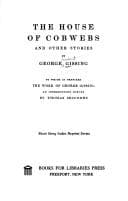
The House of Cobwebs and Other StoriesGissing, George
General
The House of Cobwebs and Other Stories
Gissing, George
Great Britain -- Social life and customs -- 19th century -- Fiction; Short stories
After _Demos_, Gissing returned in 1888 to the more sentimental and
idealistic palette which he had employed for _Thyrza_. Renewed
recollections of Tibullus and of Theocritus may have served to give his
work a more idyllic tinge. But there were much nearer sources of
inspiration for _A Life's Morning_. There must be many novels inspired by a
youthful enthusiasm for _Richard Feverel_, and this I should take to be one
of them. Apart from the idyllic purity of its tone, and its sincere
idolatry of youthful love, the caressing grace of the language which
describes the spiritualised beauty of Emily Hood and the exquisite charm of
her slender hands, and the silvery radiance imparted to the whole scene of
the proposal in the summer-house (in chapter iii., 'Lyrical'), give to this
most unequal and imperfect book a certain crepuscular fascination of its
own. Passages in it, certainly, are not undeserving that fine description
of a style _si tendre qu'il pousse le bonheur à pleurer_. Emily's father,
Mr. Hood, is an essentially pathetic figure, almost grotesquely true to
life. 'I should like to see London before I die,' he says to his daughter.
'Somehow I have never managed to get so far.... There's one thing that I
wish especially to see, and that is Holborn Viaduct. It must be a wonderful
piece of engineering; I remember thinking it out at the time it was
constructed. Of course you have seen it?' The vulgar but not wholly inhuman
Cartwright interior, where the parlour is resolved into a perpetual
matrimonial committee, would seem to be the outcome of genuine observation.
Dagworthy is obviously padded with the author's substitute for melodrama,
while the rich and cultivated Mr. Athel is palpably imitated from Meredith.
The following tirade (spoken by the young man to his mistress) is Gissing
pure. 'Think of the sunny spaces in the world's history, in each of which
one could linger for ever. Athens at her fairest, Rome at her grandest, the
glorious savagery of Merovingian Courts, the kingdom of Frederick II., the
Moors in Spain, the magic of Renaissance Italy--to become a citizen of any
one age means a lifetime of endeavour. It is easy to fill one's head with
names and years, but that only sharpens my hunger.' In one form or another
it recurs in practically every novel.[12] Certain of the later portions of
this book, especially the chapter entitled 'Her Path in Shadow' are
delineated through a kind of mystical haze, suggestive of some of the work
of Puvis de Chavannes. The concluding chapters, taken as a whole, indicate
with tolerable accuracy Gissing's affinities as a writer, and the pedigree
of the type of novel by which he is best known. It derives from Xavier de
Maistre and St. Pierre to _La Nouvelle Héloïse,_--nay, might one not almost
say from the _pays du tendre_ of _La Princesse de Clèves_ itself.
Semi-sentimental theories as to the relations of the sexes, the dangers of
indiscriminate education, the corruptions of wretchedness and poverty in
Public-domain text, read in full here on John Shaqi.
Reviews
Reviews
No reviews yet
Be the first to share your thoughts on this work.
Join the Discussion
Join the discussion
Sign in to leave a comment or review.
Sign InorCreate an account