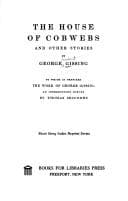
The House of Cobwebs and Other StoriesGissing, George
General
The House of Cobwebs and Other Stories
Gissing, George
Great Britain -- Social life and customs -- 19th century -- Fiction; Short stories
large towns, the neglect of literature and classical learning, and the
grievances of scholarly refinement in a world in which Greek iambic and
Latin hexameter count for nothing,--such form the staple of his theses and
tirades! His approximation at times to the confines of French realistic art
is of the most accidental or incidental kind. For Gissing is at heart, in
his bones as the vulgar say, a thorough moralist and sentimentalist, an
honest, true-born, downright ineradicable Englishman. Intellectually his
own life was, and continued to the last to be, romantic to an extent that
few lives are. Pessimistic he may at times appear, but this is almost
entirely on the surface. For he was never in the least blasé or ennuyé. He
had the pathetic treasure of the humble and downcast and unkindly
entreated--unquenchable hope. He has no objectivity. His point of view is
almost entirely personal. It is not the _lacrimae rerum_, but the _lacrimae
dierum suorum_, that makes his pages often so forlorn. His laments are all
uttered by the waters of Babylon in a strange land. His nostalgia in the
land of exile, estranged from every refinement, was greatly enhanced by the
fact that he could not get on with ordinary men, but exhibited almost to
the last a practical incapacity, a curious inability to do the sane and
secure thing. As Mr. Wells puts it:--
[Footnote 12: Sometimes, however, as in _The Whirlpool_ (1897) with a very
significant change of intonation:--'And that History which he loved to
read--what was it but the lurid record of woes unutterable! How could he
find pleasure in keeping his eyes fixed on century after century of
ever-repeated torment--war, pestilence, tyranny; the stake, the dungeon;
tortures of infinite device, cruelties inconceivable?'--(p. 326.)]
'It is not that he was a careless man, he was a most careful one; it
is not that he was a morally lax man, he was almost morbidly the
reverse. Neither was he morose or eccentric in his motives or bearing;
he was genial, conversational, and well-meaning. But he had some sort
of blindness towards his fellow-men, so that he never entirely grasped
the spirit of everyday life, so that he, who was so copiously
intelligent in the things of the study, misunderstood, blundered, was
nervously diffident, and wilful and spasmodic in common affairs, in
employment and buying and selling, and the normal conflicts of
intercourse. He did not know what would offend, and he did not know
what would please. He irritated others and thwarted himself. He had no
social nerve.'
Public-domain text, read in full here on John Shaqi.
Reviews
Reviews
No reviews yet
Be the first to share your thoughts on this work.
Join the Discussion
Join the discussion
Sign in to leave a comment or review.
Sign InorCreate an account