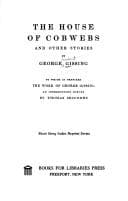
The House of Cobwebs and Other Stories — John Shaqi
The House of Cobwebs and Other StoriesGissing, George
General
The House of Cobwebs and Other Stories
Gissing, George
Great Britain -- Social life and customs -- 19th century -- Fiction; Short stories
Does not Gissing himself sum it up admirably, upon the lips of Mr.
Widdowson in _The Odd Women_: 'Life has always been full of worrying
problems for me. I can't take things in the simple way that comes natural
to other men.' 'Not as other men are': more intellectual than most, fully
as responsive to kind and genial instincts, yet bound at every turn to
pinch and screw--an involuntary ascetic. Such is the essential burden of
Gissing's long-drawn lament. Only accidentally can it be described as his
mission to preach 'the desolation of modern life,' or in the gracious
phrase of De Goncourt, _fouiller les entrailles de la vie_. Of the
confident, self-supporting realism of _Esther Waters_, for instance, how
little is there in any of his work, even in that most gloomily photographic
portion of it which we are now to describe?
During the next four years, 1889-1892, Gissing produced four novels, and
three of these perhaps are his best efforts in prose fiction. _The Nether
World_ of 1889 is certainly in some respects his strongest work, _la letra
con sangre_, in which the ruddy drops of anguish remembered in a state of
comparative tranquillity are most powerfully expressed. _The Emancipated_,
of 1890, is with equal certainty, a _réchauffé_ and the least successful of
various attempts to give utterance to his enthusiasm for the _valor
antica_--'the glory that was Greece and the grandeur that was Rome.' _New
Grub Street_, (1891) is the most constructive and perhaps the most
successful of all his works; while _Born in Exile_ (1892) is a key-book as
regards the development of the author's character, a _clavis_ of primary
value to his future biographer, whoever he may be. The _Nether World_
contains Gissing's most convincing indictment of Poverty; and it also
expresses his sense of revolt against the ugliness and cruelty which is
propagated like a foul weed by the barbarous life of our reeking slums.
Hunger and Want show Religion and Virtue the door with scant politeness in
this terrible book. The material had been in his possession for some time,
and in part it had been used before in earlier work. It was now utilised
with a masterly hand, and the result goes some way, perhaps, to justify the
well-meant but erratic comparisons that have been made between Gissing and
such writers as Zola, Maupassant and the projector of the _Comédie
Humaine_. The savage luck which dogs Kirkwood and Jane, and the worse than
savage--the inhuman--cruelty of Clem Peckover, who has been compared to the
Madame Cibot of Balzac's _Le Cousin Pons_, render the book an intensely
gloomy one; it ends on a note of poignant misery, which gives a certain
colour for once to the oft-repeated charge of morbidity and pessimism.
Gissing understood the theory of compensation, but was unable to exhibit it
in action. He elevates the cult of refinement to such a pitch that the
consolations of temperament, of habit, and of humdrum ideals which are
Public-domain text, read in full here on John Shaqi.
Reviews
Reviews
No reviews yet
Be the first to share your thoughts on this work.
Join the Discussion
Join the discussion
Sign in to leave a comment or review.
Sign InorCreate an account