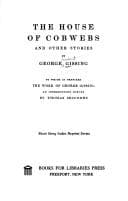
The House of Cobwebs and Other Stories — John Shaqi
The House of Cobwebs and Other StoriesGissing, George
General
The House of Cobwebs and Other Stories
Gissing, George
Great Britain -- Social life and customs -- 19th century -- Fiction; Short stories
This criticism does not seem to me a just one at all, and I dissent from it
completely. In the first place, the book is not nearly so depressing as
_The Nether World_, and is much farther removed from the strain of French
and Russian pessimism which had begun to engage the author's study when he
was writing _Thyrza_. There are dozens of examples to prove that Milvain's
success is a perfectly normal process, and the reason for his selecting the
journalistic career is the obvious one that he has no money to begin
stock-broking, still less money-lending. In the third place, the mental and
moral shortcomings of Reardon are by no means dissembled by the author. He
is, as the careful student of the novels will perceive, a greatly
strengthened and improved rifacimento of Kingcote, while Amy Reardon is a
better observed Isabel, regarded from a slightly different point of view.
Jasper Milvain is, to my thinking, a perfectly fair portrait of an
ambitious publicist or journalist of the day--destined by determination,
skill, energy, and social ambition to become an editor of a successful
journal or review, and to lead the life of central London. Possessing a
keen and active mind, expression on paper is his handle; he has no love of
letters as letters at all. But his outlook upon the situation is just
enough. Reardon has barely any outlook at all. He is a man with a delicate
but shallow vein of literary capacity, who never did more than tremble upon
the verge of success, and hardly, if at all, went beyond promise. He was
unlucky in marrying Amy, a rather heartless woman, whose ambition was far
in excess of her insight, for economic position Reardon had none. He writes
books to please a small group. The books fail to please. Jasper in the main
is right--there is only a precarious place for any creative litterateur
between the genius and the swarm of ephemera or journalists. A man writes
either to please the hour or to produce something to last, relatively a
long time, several generations--what we call 'permanent.' The intermediate
position is necessarily insecure. It is not really wanted. What is lost by
society when one of these mediocre masterpieces is overlooked? A sensation,
a single ray in a sunset, missed by a small literary coterie! The circle is
perhaps eclectic. It may seem hard that good work is overwhelmed in the
cataract of production, while relatively bad, garish work is rewarded. But
so it must be. 'The growing flood of literature swamps every thing but
works of primary genius.' Good taste is valuable, especially when it takes
the form of good criticism. The best critics of contemporary books (and
these are by no means identical with the best critics of the past and its
work) are those who settle intuitively upon the writing that is going to
appeal more largely to a future generation, when the attraction of novelty
and topicality has subsided. The same work is done by great men. They
Public-domain text, read in full here on John Shaqi.
Reviews
Reviews
No reviews yet
Be the first to share your thoughts on this work.
Join the Discussion
Join the discussion
Sign in to leave a comment or review.
Sign InorCreate an account