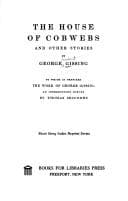
The House of Cobwebs and Other StoriesGissing, George
General
The House of Cobwebs and Other Stories
Gissing, George
Great Britain -- Social life and customs -- 19th century -- Fiction; Short stories
anticipate lines of action; philosophers generally follow (Machiavelli's
theories the practice of Louis XI., Nietzsche's that of Napoleon I.). The
critic recognises the tentative steps of genius in letters. The work of
fine delicacy and reserve, the work that follows, lacking the real
originality, is liable to neglect, and _may_ become the victim of ill-luck,
unfair influence, or other extraneous factors. Yet on the whole, so
numerous are the publics of to-day, there never, perhaps, was a time when
supreme genius or even supreme talent was so sure of recognition. Those who
rail against these conditions, as Gissing seems here to have done, are
actuated consciously or unconsciously by a personal or sectional
disappointment. It is akin to the crocodile lament of the publisher that
good modern literature is neglected by the public, or the impressionist's
lament about the great unpaid greatness of the great unknown--the
exclusively literary view of literary rewards. Literature must be governed
by over-mastering impulse or directed at profit.
But _New Grub Street_ is rich in memorable characters and situations to an
extent unusual in Gissing; Biffen in his garret--a piece of genre almost
worthy of Dickens; Reardon the sterile plotter, listening in despair to the
neighbouring workhouse clock of St. Mary-le-bone; the matutinal interview
between Alfred Yule and the threadbare surgeon, a vignette worthy of
Smollett. Alfred Yule, the worn-out veteran, whose literary ideals are
those of the eighteenth century, is a most extraordinary study of an
_arriéré_--certainly one of the most crusted and individual personalities
Gissing ever portrayed. He never wrote with such a virile pen: phrase after
phrase bites and snaps with a singular crispness and energy; material used
before is now brought to a finer literary issue. It is by far the most
tenacious of Gissing's novels. It shows that on the more conventional lines
of fictitious intrigue, acting as cement, and in the interplay of
emphasised characters, Gissing could, if he liked, excel. (It recalls
Anatole France's _Le Lys Rouge_, showing that he, too, the scholar and
intellectual _par excellence_, could an he would produce patterns in plain
and fancy adultery with the best.) Whelpdale's adventures in Troy, U.S.A.,
where he lived for five days on pea-nuts, are evidently
semi-autobiographical. It is in his narrative that we first made the
acquaintance of the American phrase now so familiar about literary
productions going off like hot cakes. The reminiscences of Athens are
typical of a lifelong obsession--to find an outlet later on in _Veranilda_.
On literary _réclame_, he says much that is true--if not the whole truth,
in the apophthegm for instance, 'You have to become famous before you can
secure the attention which would give fame.' Biffen, it is true, is a
somewhat fantastic figure of an idealist, but Gissing cherished this
grotesque exfoliation from a headline by Dickens--and later in his career
Public-domain text, read in full here on John Shaqi.
Reviews
Reviews
No reviews yet
Be the first to share your thoughts on this work.
Join the Discussion
Join the discussion
Sign in to leave a comment or review.
Sign InorCreate an account