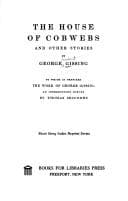
The House of Cobwebs and Other StoriesGissing, George
General
The House of Cobwebs and Other Stories
Gissing, George
Great Britain -- Social life and customs -- 19th century -- Fiction; Short stories
The conclusion of this book and its predecessor, _The Odd Women_,[20] marks
the conclusion of these elaborated problem studies. The inferno of London
poverty, social analysis and autobiographical reminiscence, had now alike
been pretty extensively drawn upon by Gissing. With different degrees of
success he had succeeded in providing every one of his theses with
something in the nature of a jack-in-the-box plot which the public loved
and he despised. There remained to him three alternatives: to experiment
beyond the limits of the novel; to essay a lighter vein of fiction; or
thirdly, to repeat himself and refashion old material within its limits.
Necessity left him very little option. He adopted all three alternatives.
His best success in the third department was achieved in _Eve's Ransom_
(1895). Burrowing back into a projection of himself in relation with a not
impossible she, Gissing here creates a false, fair, and fleeting beauty of
a very palpable charm. A growing sense of her power to fascinate steadily
raises Eve's standard of the minimum of luxury to which she is entitled.
And in the course of this evolution, in the vain attempt to win beauty by
gratitude and humility, the timid Hilliard, who seeks to propitiate his
charmer by ransoming her from a base liaison and supporting her in luxury
for a season in Paris, is thrown off like an old glove when a richer
_parti_ declares himself. The subtlety of the portraiture and the economy
of the author's sympathy for his hero impart a subacid flavour of peculiar
delicacy to the book, which would occupy a high place in the repertoire of
any lesser artist. It well exhibits the conflict between an exaggerated
contempt for, and an extreme susceptibility to, the charm of women which
has cried havoc and let loose the dogs of strife upon so many able men. In
_The Whirlpool_ of 1897, in which he shows us a number of human floats
spinning round the vortex of social London,[21] Gissing brings a
melodramatic plot of a kind disused since the days of _Demos_ to bear upon
the exhausting lives and illusive pleasures of the rich and cultured middle
class. There is some admirable writing in the book, and symptoms of a
change of tone (the old inclination to whine, for instance, is scarcely
perceptible) suggestive of a new era in the work of the
novelist--relatively mature in many respects as he now manifestly was.
Further progress in one of two directions seemed indicated: the first
leading towards the career of a successful society novelist 'of circulating
fame, spirally crescent,' the second towards the frame of mind that created
_Ryecroft_. The second fortunately prevailed. In the meantime, in
accordance with a supreme law of his being, his spirit craved that
refreshment which Gissing found in revisiting Italy. 'I want,' he cried,
'to see the ruins of Rome: I want to see the Tiber, the Clitumnus, the
Aufidus, the Alban Hills, Lake Trasimenus! It is strange how these old
times have taken hold of me.
Public-domain text, read in full here on John Shaqi.
Reviews
Reviews
No reviews yet
Be the first to share your thoughts on this work.
Join the Discussion
Join the discussion
Sign in to leave a comment or review.
Sign InorCreate an account