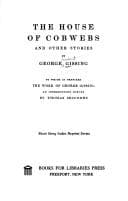
The House of Cobwebs and Other Stories — John Shaqi
The House of Cobwebs and Other StoriesGissing, George
General
The House of Cobwebs and Other Stories
Gissing, George
Great Britain -- Social life and customs -- 19th century -- Fiction; Short stories
The mere names in Roman history make my blood
warm.' Of him the saying of Michelet was perpetually true: 'J'ai passé à
côté du monde, et j'ai pris l'histoire pour la vie.' His guide-books in
Italy, through which he journeyed in 1897 (_en prince_ as compared with his
former visit, now that his revenue had risen steadily to between three and
four hundred a year), were Gibbon, his _semper eadem_, Lenormant (_la
Grande-Grèce_), and Cassiodorus, of whose epistles, the foundation of the
material of _Veranilda_, he now began to make a special study. The dirt,
the poverty, the rancid oil, and the inequable climate of Calabria must
have been a trial and something of a disappointment to him. But physical
discomfort and even sickness was whelmed by the old and overmastering
enthusiasm, which combined with his hatred of modernity and consumed
Gissing as by fire. The sensuous and the emotional sides of his experience
are blended with the most subtle artistry in his _By the Ionian Sea_, a
short volume of impressions, unsurpassable in its kind, from which we
cannot refrain two characteristic extracts:--
[Footnote 20: _The Odd Women_ (1893, new edition, 1894) is a rather sordid
and depressing survey of the life-histories of certain orphaned daughters
of a typical Gissing doctor--grave, benign, amiably diffident, terribly
afraid of life. 'From the contact of coarse actualities his nature shrank.'
After his death one daughter, a fancy-goods shop assistant (no wages), is
carried off by consumption; a second drowns herself in a bath at a
charitable institution; another takes to drink; and the portraits of the
survivors, their petty, incurable maladies, their utter uselessness, their
round shoulders and 'very short legs,' pimples, and scraggy necks--are as
implacable and unsparing as a Maupassant could wish. From the deplorable
insight with which he describes the nerveless, underfed, compulsory
optimism of these poor in spirit and poor in hope Gissing might almost have
been an 'odd woman' himself. In this book and _The Paying Guest_ (1895) he
seemed to take a savage delight in depicting the small, stiff, isolated,
costly, unsatisfied pretentiousness and plentiful lack of imagination which
cripples suburbia so cruelly.--See _Saturday Review_, 13 Apr. 1896; and see
also _ib_., 19 Jan. 1895.]
[Footnote 21: The whirlpool in which people just nod or shout to each other
as they spin round and round. The heroine tries to escape, but is drawn
back again and again, and nearly submerges her whole environment by her
wild clutches. Satire is lavished upon misdirected education (28), the
sluttishness of London landladies, self-adoring Art on a pedestal (256),
the delegation of children to underlings, sham religiosity (229), the
pampered conscience of a diffident student, and the _mensonge_ of modern
woman (300), typified by the ruddled cast-off of Redgrave, who plays first,
in her shrivelled paint, as procuress, and then, in her naked hideousness,
as blackmailer.]
Public-domain text, read in full here on John Shaqi.
Reviews
Reviews
No reviews yet
Be the first to share your thoughts on this work.
Join the Discussion
Join the discussion
Sign in to leave a comment or review.
Sign InorCreate an account