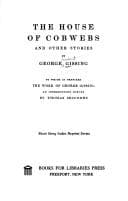
The House of Cobwebs and Other StoriesGissing, George
General
The House of Cobwebs and Other Stories
Gissing, George
Great Britain -- Social life and customs -- 19th century -- Fiction; Short stories
The _Ionian Sea_ did not make its appearance until 1901, but while he was
actually in Italy, at Siena, he wrote the greater part of one of his very
finest performances; the study of _Charles Dickens_, of which he corrected
the proofs 'at a little town in Calabria.' It is an insufficient tribute to
Gissing to say that his study of Dickens is by far the best extant. I have
even heard it maintained that it is better in its way than any single
volume in the 'Man of Letters'; and Mr. Chesterton, who speaks from ample
knowledge on this point, speaks of the best of all Dickens's critics, 'a
man of genius, Mr. George Gissing.' While fully and frankly recognising the
master's defects in view of the artistic conscience of a later generation,
the writer recognises to the full those transcendent qualities which place
him next to Sir Walter Scott as the second greatest figure in a century of
great fiction. In defiance of the terrible, and to some critics damning,
fact that Dickens entirely changed the plan of _Martin Chuzzlewit_ in
deference to the popular criticism expressed by the sudden fall in the
circulation of that serial, he shows in what a fundamental sense the author
was 'a literary artist if ever there was one,' and he triumphantly refutes
the rash daub of unapplied criticism represented by the parrot cry of
'caricature' as levelled against Dickens's humorous portraits. Among the
many notable features of this veritable _chef-d'oeuvre_ of under 250 pages
is the sense it conveys of the superb gusto of Dickens's actual living and
breathing and being, the vindication achieved of two ordinarily rather
maligned novels, _The Old Curiosity Shop_ and _Little Dorrit_, and the
insight shown into Dickens's portraiture of women, more particularly those
of the shrill-voiced and nagging or whining variety, the 'better halves' of
Weller, Varden, Snagsby and Joe Gargery, not to speak of the Miggs, the
Gummidge, and the M'Stinger. Like Mr. Swinburne and other true men, he
regards Mrs. Gamp as representing the quintessence of literary art wielded
by genius. Try (he urges with a fine curiosity) 'to imagine Sarah Gamp as a
young girl'! But it is unfair to separate a phrase from a context in which
every syllable is precious, reasonable, thrice distilled and sweet to the
palate as Hybla honey.[22]
[Footnote 22: A revised edition (the date of Dickens's birth is wrongly
given in the first) was issued in 1902, with topographical illustrations by
F.G. Kitton. Gissing's introduction to _Nickleby_ for the Rochester edition
appeared in 1900, and his abridgement of Forster's _Life_ (an excellent
piece of work) in 1903 [1902]. The first collection of short stories,
twenty-nine in number, entitled _Human Odds and Ends_, was published in
1898. It is justly described by the writer of the most interesting
'Recollections of George Gissing' in the _Gentleman's Magazine,_ February
1906, as 'that very remarkable collection.']
Public-domain text, read in full here on John Shaqi.
Reviews
Reviews
No reviews yet
Be the first to share your thoughts on this work.
Join the Discussion
Join the discussion
Sign in to leave a comment or review.
Sign InorCreate an account