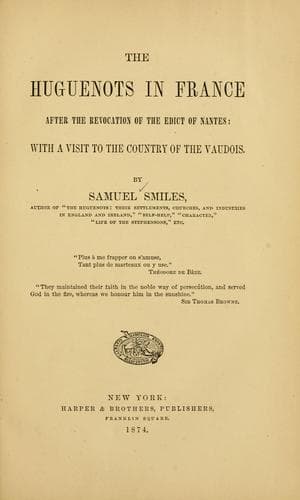
Dauphiné (France) -- Description and travel; Huguenots; Waldenses
The Jesuits were especially elated by the Revocation. It had been
brought about by the intrigues of their party, acting on the King's
mind through Madame de Maintenon and Père la Chaise. It enabled them
to fill their schools and nunneries with the children of Protestants,
who were compelled by law to pay for their education by Jesuit
priests. To furnish the required accommodation, nearly the whole of
the Protestant temples that had not been pulled down were made over
to the Jesuits, to be converted into monastic schools and nunneries.
Even Bossuet, the "last father of the Church," shared in the spoils of
the Huguenots. A few days after the Edict had been revoked, Bossuet
applied for the materials of the temples of Nauteuil and Morcerf,
situated in his diocese; and his Majesty ordered that they should be
granted to him.[6]
[Footnote 6: "Louvois et les Protestants," par Adolphe
Michel, p. 286.]
Now that Protestantism had been put down, and the officers of Louis
announced from all parts of the kingdom that the Huguenots were
becoming converted by thousands, there was nothing but a clear course
before the Jesuits in France. For their religion was now the favoured
religion of the State.
It is true there were the Jansenists--declared to be heretical by the
Popes, and distinguished for their opposition to the doctrines and
moral teaching of the Jesuits--who were suffering from a persecution
which then drove some of the members of Port Royal into exile, and
eventually destroyed them. But even the Jansenists approved the
persecution of the Protestants. The great Arnault, their most
illustrious interpreter, though in exile in the Low Countries,
declared that though the means which Louis XIV. had employed had been
"rather violent, they had in nowise been unjust."
But Protestantism being declared destroyed, and Jansenism being in
disgrace, there was virtually no legal religion in France but
one--that of the Roman Catholic Church. Atheism, it is true, was
tolerated, but then Atheism was not a religion. The Atheists did not,
like the Protestants, set up rival churches, or appoint rival
ministers, and seek to draw people to their assemblies. The Atheists,
though they tacitly approved the religion of the King, had no
opposition to offer to it--only neglect, and perhaps concealed
contempt.
Hence it followed that the Court and the clergy had far more
toleration for Atheism than for either Protestantism or Jansenism. It
is authentically related that Louis XIV. on one occasion objected to
the appointment of a representative on a foreign mission on account of
the person being supposed to be a Jansenist; but on its being
discovered that the nominee was only an Atheist, the objection was at
once withdrawn.[7]
[Footnote 7: _Quarterly Review._]
Public-domain text, read in full here on John Shaqi.
Reviews
Reviews
No reviews yet
Be the first to share your thoughts on this work.
Join the Discussion
Join the discussion
Sign in to leave a comment or review.
Sign InorCreate an account