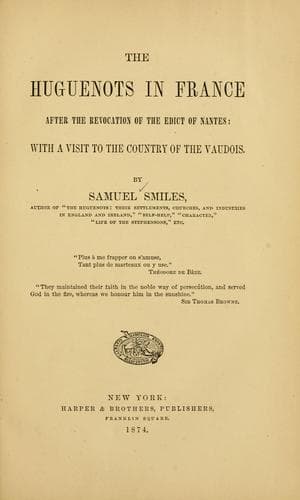
Dauphiné (France) -- Description and travel; Huguenots; Waldenses
The philosophic La Bruyère contributed a maxim in praise of the
Revocation. Quinault wrote a poem on the subject; and Madame
Deshoulières felt inspired to sing "The Destruction of Heresy." The
Abbé de Rancé spoke of the whole affair as a prodigy: "The Temple of
Charenton destroyed, and no exercise of Protestantism, within the
kingdom; it is a kind of miracle, such as we had never hoped to have
seen in our day."
The Revocation was popular with the lower class, who went about
sacking and pulling down the Protestant churches. They also tracked
the Huguenots and their pastors, where they found them evading or
breaking the Edict of Revocation; thus earning the praises of the
Church and the fines offered by the King for their apprehension. The
provosts and sheriffs of Paris represented the popular feeling, by
erecting a brazen statue of the King who had rooted out heresy; and
they struck and distributed medals in honour of the great event.
The Revocation was also popular with the dragoons. In order to
"convert" the Protestants, the dragoons were unduly billeted upon
them. As both officers and soldiers were then very badly paid, they
were thereby enabled to live at free quarters. They treated everything
in the houses they occupied as if it were their own, and an assignment
of billets was little loss than the consignment of the premises to the
military, to use for their own purposes, during the time they occupied
them.[4]
[Footnote 4: Sir John Reresby's Travels and Memoirs.]
The Revocation was also approved by those who wished to buy land
cheap. As the Huguenots were prevented holding their estates unless
they conformed to the Catholic religion, and as many estates were
accordingly confiscated and sold, land speculators, as well as grand
seigneurs who wished to increase their estates, were constantly on the
look-out for good bargains. Even before the Revocation, when the
Huguenots were selling their land in order to leave the country,
Madame de Maintenon wrote to her nephew, for whom she had obtained
from the King a grant of 800,000 francs, "I beg of you carefully to
use the money you are about to receive. Estates in Poitou may be got
for nothing; the desolation of the Huguenots will drive them to sell
more. You may easily acquire extensive possessions in Poitou."
The Revocation was especially gratifying to the French Catholic
Church. The Pope, of course, approved of it. _Te Deums_ were sung at
Rome in thanksgiving for the forced conversion of the Huguenots. Pope
Innocent XI. sent a brief to Louis XIV., in which he promised him the
unanimous praises of the Church, "Amongst all the proofs," said he,
"which your Majesty has given of natural piety, not the least
brilliant is the zeal, truly worthy of the most Christian King, which
has induced you to revoke all the ordinances issued in favour of the
heretics of your kingdom."[5]
[Footnote 5: Pope Innocent XI.'s Letter of November 13th,
1685.]
Public-domain text, read in full here on John Shaqi.
Reviews
Reviews
No reviews yet
Be the first to share your thoughts on this work.
Join the Discussion
Join the discussion
Sign in to leave a comment or review.
Sign InorCreate an account