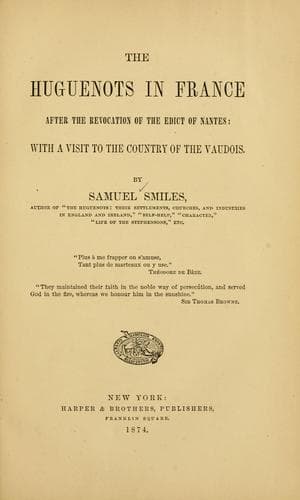
Dauphiné (France) -- Description and travel; Huguenots; Waldenses
What the so-called friends of the working classes are aiming at in
England, has already been effected in France. The public museums and
picture-galleries are open on Sunday. But you look for the working
people there in vain. They are at work in the factories, whose
chimneys are smoking as usual; or building houses, or working in the
fields, or they are engaged in the various departments of labour. The
government works all go on as usual on Sundays. The railway trains run
precisely as on week days. In short, the Sunday is secularised, or
regarded but as a partial holiday.[99]
[Footnote 99: I find the following under the signature of "An
Operative Bricklayer," in the _Times_ of the 30th July, 1867:
"I found there were a great number of men in Paris that
worked on the buildings who were not residents of the city.
The bricklayers are called _limousins_; they come from the
old province Le Limousin, where they keep their home, and
many of them are landowners. They work in Paris in the summer
time; they come up in large numbers, hire a place in Paris,
and live together, and by so doing they live cheap. In the
winter time, when they cannot work on the buildings, they go
back home again and take their savings, and stop there until
the spring, which is far better than it is in London; when
the men cannot work they are hanging about the streets. It
was with regret that I saw so many working on the Sunday
desecrating the Sabbath. I inquired why they worked on
Sunday; they told me it was to make up the time they lose
through wet and other causes. I saw some working with only
their trousers and shoes on, with a belt round their waist to
keep their trousers up. Their naked back was exposed to the
sun, and was as brown as if it had been dyed, and shone as if
it had been varnished. I asked if they had any hard-working
hearty old men. They answered me "No; the men were completely
worn out by the time they reached forty years." That was a
clear proof that they work against the laws of nature. I
thought to myself--Glory be to you, O Englishmen, you know
the Fourth Commandment; you know the value of the seventh
day, the day of rest!"]
As you pass through the country on Sundays, as on week-days, you see
the people toiling in the fields. And as dusk draws on, the dark
figures may be seen moving about so long as there is light to see by.
It is the peasants working the land, and it is _their own_. Such is
the "magical influence of property," said Arthur Young, when he
observed the same thing.
Public-domain text, read in full here on John Shaqi.
Reviews
Reviews
No reviews yet
Be the first to share your thoughts on this work.
Elsewhere in the archive
Join the Discussion
Join the discussion
Sign in to leave a comment or review.
Sign InorCreate an account