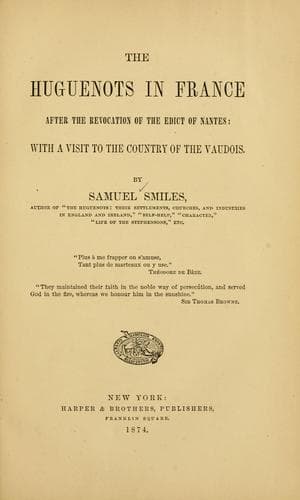
Dauphiné (France) -- Description and travel; Huguenots; Waldenses
It is to be feared, however, that the French peasantry are afflicted
with the disease which Sir Walter Scott called the "earth-hunger;" and
there is danger of the gravel getting into their souls. Anyhow, their
continuous devotion to bodily labour, without a seventh day's rest,
cannot fail to exercise a deteriorating effect upon their physical as
well as their moral condition; and this we believe it is which gives
to the men, and especially to the women of the country, the look of a
prematurely old and overworked race.
CHAPTER II.
THE VALLEY OF THE ROMANCHE--BRIANÇON.
The route from Grenoble to the frontier fortress of Briançon lies for
the most part up the valley of the Romanche, which presents a variety
of wild and beautiful scenery. In summer the river is confined within
comparatively narrow limits; but in autumn and spring it is often a
furious torrent, flooding the low-lying lands, and forcing for itself
new channels. The mountain heights which bound it, being composed for
the most part of schist, mica slate, and talcose slate, large masses
become detached in winter--split off by the freezing of the water
behind them--when they descend, on the coming of thaw, in terrible
avalanches of stone and mud. Sometimes the masses are such as to dam
up the river and form temporary lakes, until the accumulation of force
behind bursts the barrier, and a furious flood rushes down the valley.
By one of such floods, which occurred a few centuries since, through
the bursting of the hike of St. Laurent in the valley of the Romanche,
a large part of Grenoble was swept away, and many of the inhabitants
were drowned.
The valley of the Romanche is no sooner entered, a few miles above
Grenoble, than the mountains begin to close, the scenery becomes
wilder, and the fury of the torrent is evinced by the masses of débris
strewed along its bed. Shortly after passing the picturesque defile
called L'Étroit, where the river rushes through a deep cleft in the
rocks, the valley opens out again, and we shortly come in sight of the
ancient town of Vizille--the most prominent building in which is the
château of the famous Duc de Lesdiguières, governor of the province in
the reign of Henry IV., and Constable of France in that of Louis XIII.
* * * * *
Public-domain text, read in full here on John Shaqi.
Reviews
Reviews
No reviews yet
Be the first to share your thoughts on this work.
Elsewhere in the archive
Join the Discussion
Join the discussion
Sign in to leave a comment or review.
Sign InorCreate an account