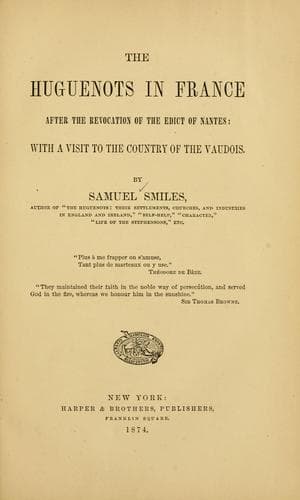
Dauphiné (France) -- Description and travel; Huguenots; Waldenses
Three months later, the great Bossuet, the eagle of Meaux, preached
the funeral sermon of Le Tellier; in the course of which he testified
to the immense joy of the Church at the Revocation of the Edict. "Let
us," said he, "expand our hearts in praises of the piety of Louis. Let
our acclamations ascend to heaven, and let us say to this new
Constantine, this new Theodosius, this new Marcian, this new
Charlemagne, what the thirty-six fathers formerly said in the Council
of Chalcedon: 'You have affirmed the faith, you have exterminated the
heretics; it is a work worthy of your reign, whose proper character it
is. Thanks to you, heresy is no more. God alone can have worked this
marvel. King of heaven, preserve the King of earth: it is the prayer
of the Church, it is the prayer of the Bishops.'"[2]
[Footnote 2: Bossuet, "Oraison Funèbre du Chancelier
Letellier."]
Madame de Maintenon also received the praises of the Church. "All good
people," said the Abbé de Choisy, "the Pope, the bishops, and all the
clergy, rejoice at the victory of Madame de Maintenon." Madame enjoyed
the surname of Director of the Affairs of the Clergy; and it was said
by the ladies of St. Cyr (an institution founded by her), that "the
cardinals and the bishops knew no other way of approaching the King
save through her."
It is generally believed that her price for obtaining the King's
consent to the Act of Revocation, was the withdrawal by the clergy of
their opposition to her marriage with the King; and that the two were
privately united by the Archbishop of Paris at Versailles, a few days
after, in the presence of Père la Chaise and two more witnesses. But
Louis XIV. never publicly recognised De Maintenon as his wife--never
rescued her from the ignominious position in which she originally
stood related to him.
People at court all spoke with immense praises of the King's
intentions with respect to destroying the Huguenots. "Killing them
off" was a matter of badinage with the courtiers. Madame de Maintenon
wrote to the Duc de Noailles, "The soldiers are killing numbers of the
fanatics--they hope soon to free Languedoc of them."
That picquante letter-writer, Madame de Sévigné, often referred to the
Huguenots. She seems to have classed them with criminals or wild
beasts. When residing in Low Brittany during a revolt against the
Gabelle, a friend wrote to her, "How dull you must be!" "No," replied
Madame de Sévigné, "we are not so dull--hanging is quite a refreshment
to me! They have just taken twenty-four or thirty of these men, and
are going to throw them off."
Public-domain text, read in full here on John Shaqi.
Reviews
Reviews
No reviews yet
Be the first to share your thoughts on this work.
Join the Discussion
Join the discussion
Sign in to leave a comment or review.
Sign InorCreate an account