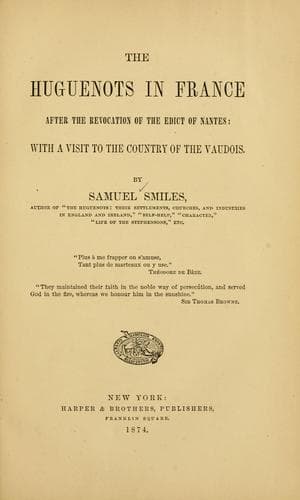
Dauphiné (France) -- Description and travel; Huguenots; Waldenses
A few days after the Edict had been revoked, she wrote to her cousin
Bussy, at Paris: "You have doubtless seen the Edict by which the King
revokes that of Nantes. There is nothing so fine as that which it
contains, and never has any King done, or ever will do, a more
memorable act." Bussy replied to her: "I immensely admire the conduct
of the King in destroying the Huguenots. The wars which have been
waged against them, and the St. Bartholomew, have given some
reputation to the sect. His Majesty has gradually undermined it; and
the edict he has just published, maintained by the dragoons and by
Bourdaloue,[3] will soon give them the _coup de grâce_."
[Footnote 3: Bourdaloue had just been sent from the Jesuit
Church of St. Louis at Paris, to Montpellier, to aid the
dragoons in converting the Protestants, and bringing them
back to the Church.]
In a future letter to Count Bussy, Madame de Sévigné informed him of
"a dreadfully fatiguing journey which her son-in-law M. de Grignan had
made in the mountains of Dauphiny, to pursue and punish the miserable
Huguenots, who issued from their holes, and vanished like ghosts to
avoid extermination."
De Baville, however, the Lieutenant of Languedoc, kept her in good
heart. In one of his letters, he said, "I have this morning condemned
seventy-six of these wretches (Huguenots), and sent them to the
galleys." All this was very pleasant to Madame de Sévigné.
Madame de Scuderi, also, more moderately rejoiced in the Act of
Revocation. "The King," she wrote to Bussy, "has worked great marvels
against the Huguenots; and the authority which he has employed to
unite them to the Church will be most salutary to themselves and to
their children, who will be educated in the purity of the faith; all
this will bring upon him the benedictions of Heaven."
Even the French Academy, though originally founded by a Huguenot,
publicly approved the deed of Revocation. In a discourse uttered
before it, the Abbé Tallemand exclaimed, when speaking of the Huguenot
temple at Charenton, which had just been destroyed by the mob, "Happy
ruins, the finest trophy France ever beheld!" La Fontaine described
heresy as now "reduced to the last gasp." Thomas Corneille also
eulogized the zeal of the King in "throttling the Reformation."
Barbier D'Aucourt heedlessly, but truly, compared the emigration of
the Protestants "to the departure of the Israelites from Egypt." The
Academy afterwards proposed, as the subject of a poem, the Revocation
of the Edict of Nantes, and Fontenelle had the fortune, good or bad,
of winning the prize.
Public-domain text, read in full here on John Shaqi.
Reviews
Reviews
No reviews yet
Be the first to share your thoughts on this work.
Join the Discussion
Join the discussion
Sign in to leave a comment or review.
Sign InorCreate an account