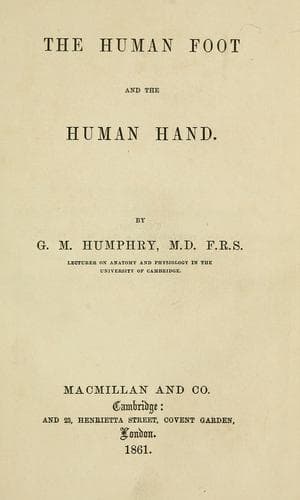
The human foot and the human handHumphry, George Murray, Sir
Science
The human foot and the human hand
Humphry, George Murray, Sir
Foot; Hand
Not only may the hand thus serve, to some extent, as a substitute
for some of the other senses; it is also a most important auxiliary
to them. Particularly is it so to the sense of sight, by proving, or
correcting, the impressions which we receive through the eye. Without
its aid we should often fail to distinguish between a real object and
a picture or a reflection in a mirror, and should have difficulty in
judging of size, shape, distance, &c.
_Relation of the Hand to the Eye and the Mouth._
You cannot have watched a game of cricket without being struck by the
manner in which the hand acts in harmony with the eye. With what almost
lightning-like rapidity it is in the exact place to catch the ball;
and with what precision the practised cricketer can throw the ball to
a great distance. In this, however, he is surpassed by the wonderful
skill with which the Indian throws the lasso. Again, it is enough for
the sportsman merely to get sight of the bird; he is scarcely conscious
of the process by which the hand directs the gun and pulls the trigger
at the exact moment. Still more remarkable is the successful aim when
taken, as it occasionally is, without bringing the gun to the shoulder.
In estimating the importance of the hand, you must not forget that
the mouth is quite dependent upon it for supplies. In most other
animals the jaws are prolonged, forwards, from the cranium, and the
head is placed in such a position that the mouth becomes an organ of
prehension, and is enabled to provide for itself. But, in man, the head
is carried so high above the ground, and the jaws are so shortened and
compressed beneath the forehead, that the mouth is of little use in
obtaining food. Its abilities and duties are restricted to receiving,
masticating, and swallowing; and, if it had to rely upon its own
efforts for supplies of food, it would, indeed, be in a poor case. When
we look at one of the Sphinxes from Egypt, or at one of the stately
Bulls from Nineveh, in which wisdom and power are represented by
joining a human head to the trunk and limbs of an animal, the question
suggests itself, “How is that mouth to be fed?” In the Centaur and
Mermaid this difficulty is overcome by adding the hands, as well as
the human head, to the trunk and locomotory organs of the horse in the
one instance, and the fish in the other; so that monstrosity does not
preclude the means of sustentation. Sufficient incongruities, however,
still remain to justify the exclamation
“Spectatum admissi risum teneatis amici?”
Public-domain text, read in full here on John Shaqi.
Reviews
Reviews
No reviews yet
Be the first to share your thoughts on this work.
Elsewhere in the archive
Join the Discussion
Join the discussion
Sign in to leave a comment or review.
Sign InorCreate an account